
Patterns
Generic systems often appear cost-effective at the start, but their true cost emerges over time through lengthy implementations, slow change cycles, growing vendor dependency, and foundations that make AI difficult to adopt. A purpose-built, AI-native approach changes the equation.
Generic platforms often promise transformation. Modern tools. Better reporting. Improved efficiency. A foundation for future innovation.
Yet for many civic organizations, the reality looks very different.
Implementations take longer than expected. Simple changes become projects. Staff become dependent on consultants and vendors to maintain core operations. And when organizations finally begin exploring AI, they discover that years of accumulated workarounds and customizations have made adoption more difficult and more expensive than anticipated.
The challenge is not that these platforms are poorly built. The challenge is that they were built for someone else's work.
What appears affordable at the start often becomes increasingly costly over time—not just financially, but operationally.
The Three Hidden Costs of Generic Systems
Most technology decisions begin with two numbers - licensing fee and implementation cost. Neither captures the full cost of operating the platform over the next five years and the real costs emerge later.
Hidden Cost #1: Every Implementation Starts with Translation
Most generic platforms were designed for commercial organizations, not civic ones. That means organizations must translate their work into structures the platform understands. People become contacts. Services become tickets. Programs become workflows. Outcomes become reports.
What seems like a straightforward implementation quickly becomes an exercise in adaptation. Consultants configure custom fields. Teams build workarounds. Processes are redesigned to fit the software rather than the other way around. Months later, organizations often find themselves operating a system that approximates their work rather than fully supporting it.
Implementation becomes more than a technology project. It becomes a significant investment of staff time, leadership attention, and organizational energy. And even after go-live, many organizations continue filling gaps through spreadsheets, manual processes, and institutional knowledge.
The implementation debt begins before the platform is even live.
Hidden Cost #2: Every Change Becomes a Project
Civic organizations operate in a constantly changing environment. New funding requirements emerge. Programs evolve. The community needs shift. Policies and regulations change.
The challenge is that many generic platforms were not designed to be adapted by the people doing the work. Simple operational changes often require consultants, technical specialists, or formal projects. A new intake process. A new service category. A new reporting requirement.
Each becomes another request, another budget conversation, and another delay. Organizations become dependent on vendors to change how they operate. Over time, change slows while backlogs grow and workarounds multiply with staff creating unofficial processes outside the system simply to keep work moving.
What began as a platform intended to increase flexibility gradually becomes a constraint on it.
Hidden Cost #3: Every Year Makes AI Harder
AI has the potential to help civic organizations increase capacity, improve coordination, and reduce administrative burden. But AI is only as effective as the foundation beneath it.
After years of customizations, disconnected workflows, inconsistent data, and accumulated workarounds, many organizations discover that AI cannot simply be turned on. Before AI can provide meaningful value, organizations often need to clean data, standardize processes, document workflows, and reconcile information spread across multiple systems.
The effort required to prepare for AI becomes a project of its own. Organizations invest significant time and resources preparing for AI, only to receive limited value in return. AI can answer questions. It can generate content. But without connected operational context, it struggles to prioritize work, coordinate services, surface risks, or support decision-making at scale.
The organizations that could benefit most from AI often face the greatest barriers to adopting it successfully.
"The greatest cost of generic systems isn't the software itself. It's the debt that accumulates through every customization, every workaround, and every change that becomes a project."
What It Takes to Break the Cycle
The technical debt trap is not broken by buying a better generic platform. It is broken by recognizing that the debt is structural — built into the architecture of tools designed for a different sector — and that the solution requires a different architectural starting point.
Three principles define what that starting point looks like.
Purpose-built, not adapted.
Technology designed for civic work should understand civic work from the start. People, households, services, programs, cases, and outcomes should not need to be translated into commercial concepts before organizations can use them.
When the platform reflects how organizations already operate, implementation becomes significantly simpler and organizations spend less time adapting the system to fit their mission.
AI-native, not AI-added.
AI creates the greatest value when it operates within connected information, structured workflows, and clearly defined operational context.
Rather than layering AI onto fragmented systems, organizations need a foundation where AI can immediately help prioritize work, assemble context, identify risks, and recommend actions.
The difference is not having AI features but having infrastructure designed to support AI from the beginning.
Configured, not customized.
Organizations should be able to adapt their operations without launching a project. The change-cycle dependency that creates permanent vendor lock is dissolved by a platform where configuration — not customization — is the mechanism for adaptation.
On a configured platform, a new funder requirement is a workflow change made by the program manager in an afternoon. A new service type is an attribute added by the coordinator who runs the program. A new reporting structure is a dashboard built by the person who needs to read it. The organization owns its operations ending the vendor dependency.
Configuration creates flexibility.
Customization creates dependency.
"When technology is purpose-built, configurable, and AI-native, organizations spend less time managing systems and more time advancing their mission."
What Connected Brings: The Architecture That Breaks the Trap
Connected was built to address the hidden costs that generic platforms create.
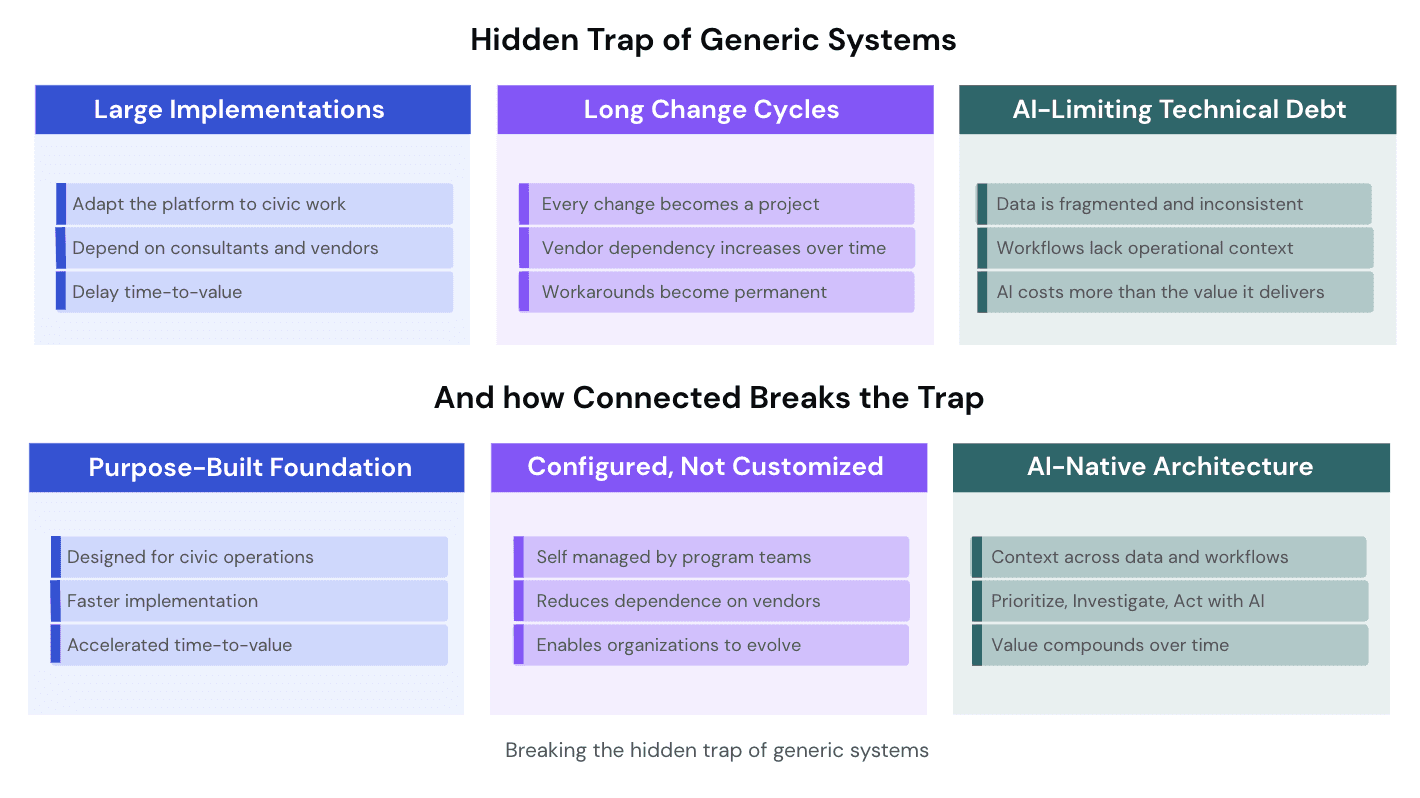
Purpose-Built Foundation
Connected was built for civic organizations from the ground up — connecting people, services, cases, programs, and outcomes within a single operational foundation.
Organizations spend less time translating their work into the system and more time using the system to advance their mission.
Configuration That Returns Control
Every element of Connected that shapes how the platform works — workflows, forms, case types, SLA thresholds, role definitions — is configured by the program team using the platform's built-in tools. Adaptation is designed in, not bolted on, giving organizations control of how they operate rather than depending on vendors to make routine changes.
The result is not just a lower total cost of ownership. It is a fundamentally different relationship between the organization and its infrastructure: one where the platform serves the mission rather than managing it, and where the cost of keeping up with the work never exceeds the value of doing it.
AI-Native Architecture
Because Connected provides connected information, structured workflows, and operational context from day one, AI can begin creating value immediately.
It helps organizations prioritize work, assemble relevant context, surface emerging risks, and support decision-making across the service journey.
The Cost of Standing Still
The technical debt trap is rarely visible in a single budget line. It appears as delayed projects, consulting fees, staff frustration, manual workarounds and missed opportunities. And increasingly, the inability to benefit from technologies that could significantly increase organizational capacity.
The challenge facing civic organizations today is not whether technology matters. It is whether the technology they rely on was designed to evolve with them.
Breaking the cycle requires more than replacing one system with another. It requires a foundation built for civic work from the start—one that reduces dependency, adapts as organizations change, and creates the conditions for AI to deliver meaningful value.
That is the foundation Connected was built to provide.
Key Takeaways
The true cost of generic systems extends far beyond licensing fees, creating implementation complexity, operational dependency, and growing technical debt.
As programs evolve, even simple changes often require consultants, projects, and additional budget, slowing organizations down and increasing costs over time.
AI delivers the greatest value when built on connected data and structured workflows, yet many organizations must first overcome years of accumulated technical debt before they can benefit.
Purpose-built, AI-native platforms reduce implementation effort, simplify ongoing adaptation, and provide a stronger foundation for future innovation.
Connected was designed to help organizations break the cycle through a purpose-built foundation, AI-native architecture, and configuration that puts control back in the hands of program teams.