
Platform
Civic organizations didn't choose fragmented systems—they accumulated them over time. What began as individual solutions to individual problems has become a patchwork of tools, spreadsheets, and workarounds that create operational friction, make impact harder to demonstrate, and limit the ability to scale. This article explores the true cost of the patchwork and what becomes possible when the civic value chain is connected end to end.
Every civic organization knows the patchwork. It rarely appears all at once. It grows over time - one tool, one gap, one workaround at a time.
A donor CRM is added to manage fundraising. A volunteer platform helps coordinate community engagement. A case management system supports a specific program. Spreadsheets fill the gaps. Email becomes the glue holding everything together.
Each decision makes sense in isolation. Together, they create an operating environment that is increasingly difficult to manage. The result is a patchwork of systems, processes, and workarounds that consume staff time, complicate reporting, and make it harder to deliver services at the scale communities need.
The patchwork is not a temporary state. It is a stable equilibrium that organizations settle into because changing it feels more risky than staying in it. Understanding what the patchwork costs—and what becomes possible beyond it—is the argument for doing something different.
Why the Patchwork Persists
The civic value chain runs from community member to outcome. A community member engages with an organization, services are coordinated, needs are addressed, and an outcome is produced. At each link in this chain, the patchwork has a partial solution — and a significant gap.
The patchwork doesn't just create gaps between systems. It creates disconnected experiences for the people delivering services and the communities receiving them.
“The patchwork doesn't just leave gaps in the data. It leaves gaps in the chain that community members fall through.”
The Hidden Costs of the Patchwork
The true cost of fragmented operations extends far beyond technology. It affects people, processes, outcomes, and resources every day.
People: Carrying the System on Their Shoulders
The human cost of the patchwork is carried by the staff who hold it together. Program coordinators who know which spreadsheet contains the latest information. Case workers who remember details that never made it into a platform. Directors who understand which tool is authoritative for which question.
Over time, people become the connectors between disconnected systems. While this demonstrates remarkable dedication, it also creates risk - every departure creates gaps in knowledge, every onboarding is a months-long apprenticeship, and every absence creates a coordination crisis.
When information is difficult to find, confidence in decision-making suffers.
The anxiety of missing key information is not about the volume of data. It is about the impossibility of knowing, at any given moment, whether the picture is complete. |
Operations: Friction Hidden in Everyday Work
The operational reality of civic organizations running on patchwork tools is not a single broken workflow — it is the accumulation of hundreds of small workarounds that each cost a few minutes, a few errors, and a few missed opportunities.
Tasks managed through email — no record, no tracking, no accountability, no visibility for anyone not on the thread
Workflows built in shared docs — editable by anyone, auditable by no one, abandoned when the person who built them leaves
SLA awareness through memory — caseworkers know when a deadline is approaching because they remember it, not because the system told them
Program changes managed through chaos — every new requirement means a new spreadsheet, a new column, a new meeting to explain it to everyone
The pressure of day-to-day operations is not from the volume of work. It is from the friction of tools that were not built to coordinate it. |
Outcomes: Impact That Is Difficult to Demonstrate
At the end of the chain, the patchwork extracts its heaviest toll: producing evidence of impact from a system that was never designed to generate it.
Funder reports require hours of manual work: exporting data from multiple systems, reconciling discrepancies, formatting for each funder's template, and writing narratives that attempt to tell the story the data cannot tell on its own. The outcome happened. The proof is painful to produce.
And because the proof is painful, it is never as rich as the funders want or as accurate as the organization knows it should be. Approximate numbers. Conservative claims. Impact understated because the effort to document it precisely exceeded the capacity available.
The cost of proving impact is not in doing the work — it is in extracting the evidence from a system that was never designed to capture it. |
The Cost Is Greater Than the Invoice
The financial cost of the patchwork is rarely calculated because it is distributed across too many budget lines. Subscriptions for tools that overlap. IT overhead for integrations that break. Staff time spent on workarounds that do not appear in any time-tracking system. Implementations that never fully deliver on the promised ROI.
And beneath all of it, technical debt: every workaround that becomes a habit, every integration that becomes a dependency, every process documented in a spreadsheet that becomes an unmaintainable system. The debt compounds. The cost of changing grows. The patchwork becomes harder to leave.
“The patchwork is not cheap. Its cost is just distributed in ways that make it invisible — until the moment it becomes undeniable.”
What Connected Brings: Autonomy, Agency, Acceleration
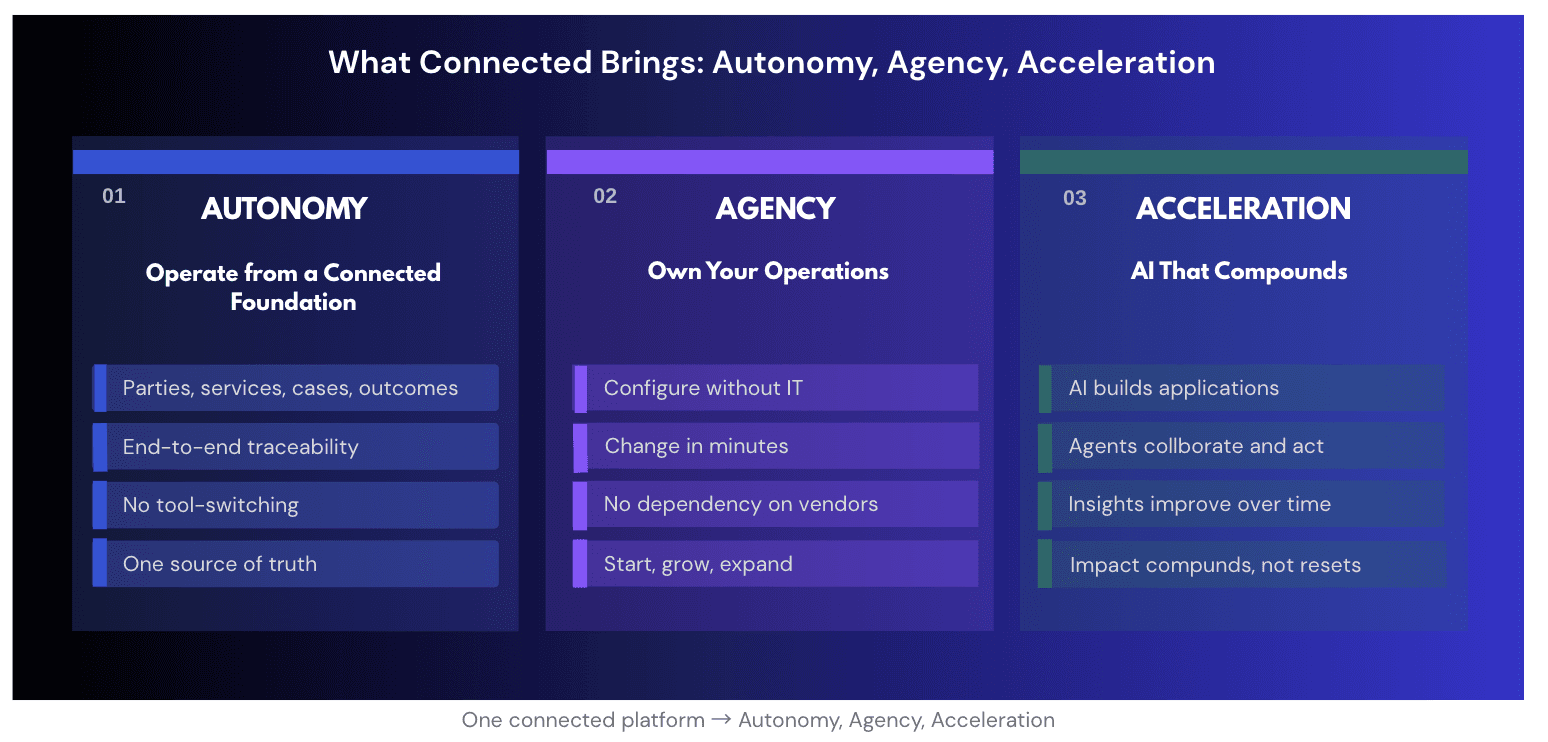
01 — Autonomy: Operate from a Connected Foundation
Connected replaces the patchwork with a unified foundation that spans the civic value chain. Instead of managing community members, services, cases, programs, and outcomes across disconnected systems, organizations operate from a single source of truth.
When information flows across the entire organization, staff gain a clearer understanding of the people they serve, the services they provide, and the outcomes they create. Decisions become easier, coordination becomes more effective, and critical information is no longer trapped in individual tools or institutional knowledge.
Instead of reconstructing the story later, the story becomes visible as work happens.
02 — Agency: Configure Freely, Own Your Operations
The patchwork creates a particular kind of dependency. Organizations become dependent on vendors, consultants, integrations, and the handful of people who know how everything works.
Connected returns agency to the organization. The people closest to the work can adapt workflows, processes, forms, service models, and operational requirements as needs evolve—without developers, lengthy implementation projects, or waiting on someone else's roadmap. Agency means owning how you operate rather than adapting your operations to fit your software.
03 — Exponential Acceleration: AI That Compounds
The patchwork was never designed for AI. Unlocking AI's full potential requires connected information, structured workflows, and operational context that AI can understand and act upon. For many civic organizations, building that foundation requires significant data cleanup, integration work, and process redesign—creating barriers to adopting a technology that could meaningfully increase capacity and improve service delivery.
Connected changes this by providing the foundation AI needs from day one. With connected records, structured workflows, and traceable outcomes, AI can help organizations prioritize work, assemble context, surface risks, recommend actions, and reduce administrative burden.
Every interaction strengthens the foundation, helping organizations increase capacity, improve responsiveness, and accelerate impact over time.
Moving Beyond the Patchwork
The patchwork emerged because organizations adopted the tools available to them. As expectations continue to rise—from communities, funders, partners, and regulators—the limitations of fragmented operations become increasingly difficult to ignore.
Modernizing the civic value chain requires more than another application. It requires a connected foundation that brings together people, services, operations, and outcomes.
A foundation that gives organizations greater visibility, greater capacity and ultimately, greater impact.
That is what exists beyond the patchwork.
Beyond the patchwork is not a different set of tools. It is a different foundation — one that connects the chain, returns agency to the organization, and accelerates with every interaction. |
Key Takeaways
Most civic organizations operate on a patchwork of disconnected tools that were never designed to work together.
The costs of the patchwork extend beyond technology, creating cognitive overload for staff, operational inefficiencies, reporting challenges, and growing technical debt.
Critical information often lives in spreadsheets, emails, and institutional knowledge, making organizations dependent on people rather than systems.
As accountability expectations increase and resources remain constrained, the cost of maintaining fragmented operations continues to rise.
Connected replaces the patchwork with a unified foundation that connects people, services, operations, and outcomes while giving organizations greater flexibility and leveraging AI to increase capacity.