
Purpose
The Civic Operations Gap persists because civic organizations were never given technology designed for the way they work. Disconnected tools, software focused on reporting rather than operations, and a missing foundation for AI have created barriers that limit efficiency, accountability, and impact. This article explores the root causes of the gap and how a purpose-built, AI-native foundation can help civic organizations close it.
Technology has transformed how organizations operate across nearly every sector. Yet many civic organizations still rely on a patchwork of systems, spreadsheets, emails, and manual processes to coordinate the work that matters most.
Ask a nonprofit program director what software they use to run their organization and the answer is rarely a single platform. More often, it is a collection of tools assembled over time: a donor CRM, a volunteer management system, a case management application, spreadsheets for coordination, email for collaboration, and reporting tools layered on top.
Each tool solves a specific problem. Together, they create operational complexity.
The result is what we call the Civic Operations Gap: the growing disconnect between what civic organizations are expected to deliver and the systems available to support that work.
This gap is not caused by a lack of commitment, innovation, or expertise. It exists because most technology available to the civic sector was never designed for the way civic organizations operate.
Three structural issues continue to drive the gap today:
Point solutions borrowed from platforms built for other industries.
Software designed to measure outcomes rather than support the work that creates them.
A missing operational foundation that prevents organizations from fully benefiting from AI.
Understanding why these challenges persist is the first step toward addressing them.
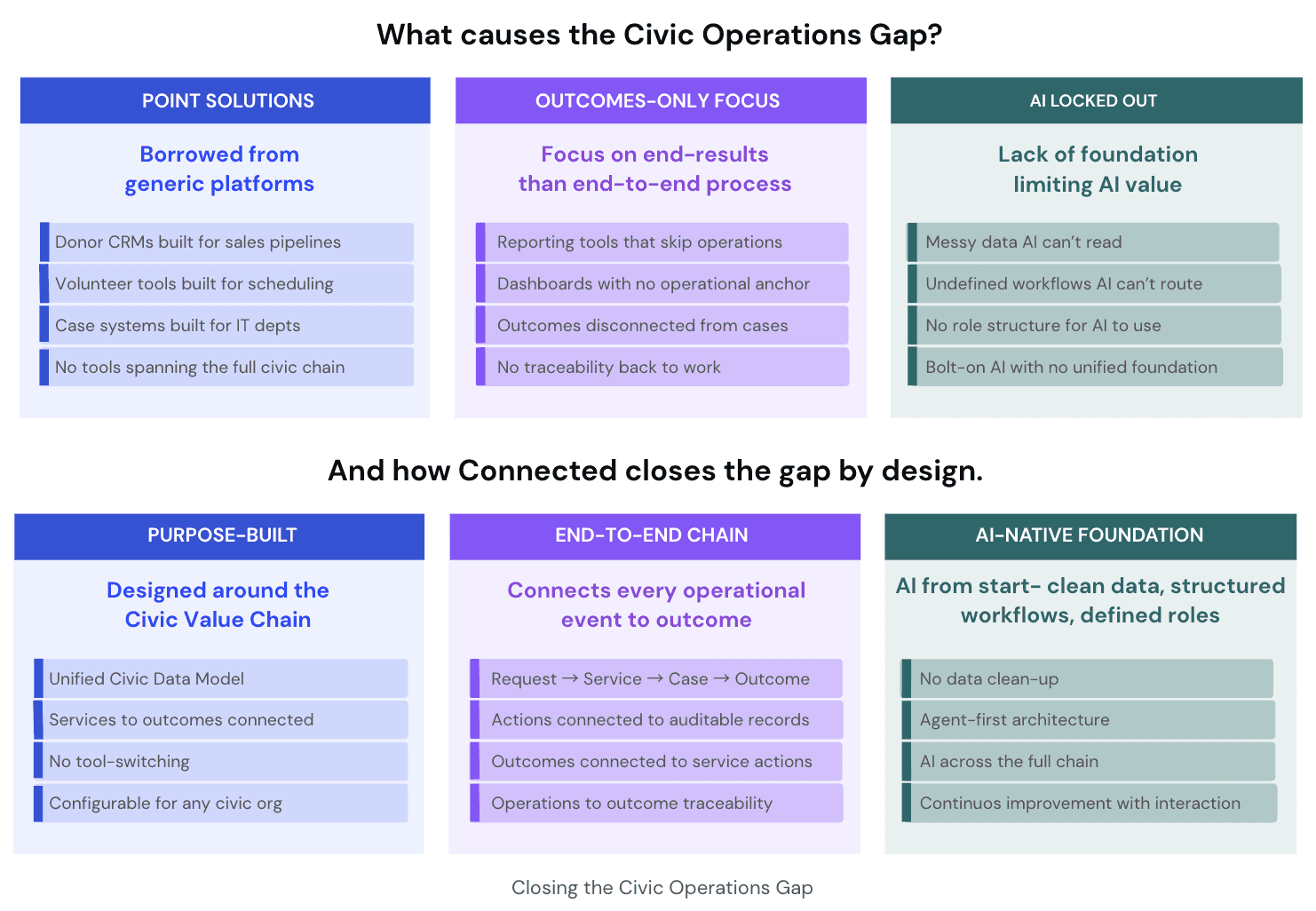
The Three Root Causes of the Civic Operations Gap
Root Cause 1: Point Solutions Built for Someone Else's Problems
The civic sector did not choose fragmented systems because they were ideal. Organizations adopted the tools that were available.
Many donor management systems evolved from platforms built for commercial sales contexts, not community service. Volunteer management tools focused on scheduling rather than community engagement. Case management systems often addressed a specific program need without supporting broader organizational operations.
Each tool solved part of the problem. Few were designed to support the full journey from community engagement to service delivery to measurable impact.
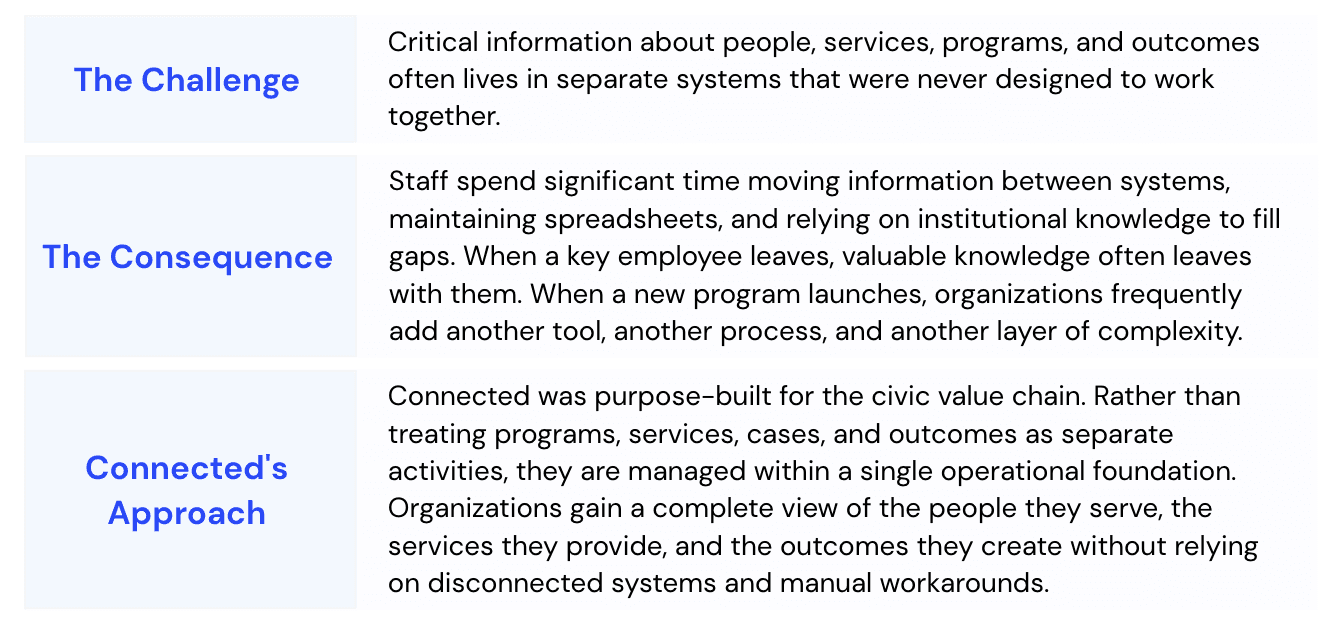
"The civic sector was given tools designed for someone else's problems and asked to use them to solve some of society's most complex coordination challenges."
Root Cause 2: Software Focused on Outcomes Rather Than the Work That Creates Them
A second challenge runs deeper than fragmented technology.
Many civic platforms were designed to measure outcomes after the fact rather than support the operational work required to achieve those outcomes.
Organizations collect data, build reports, and submit grant updates. Yet the day-to-day work that produced those results often remains disconnected from the metrics being reported.
The outcome is visible. The journey that created it is often not.
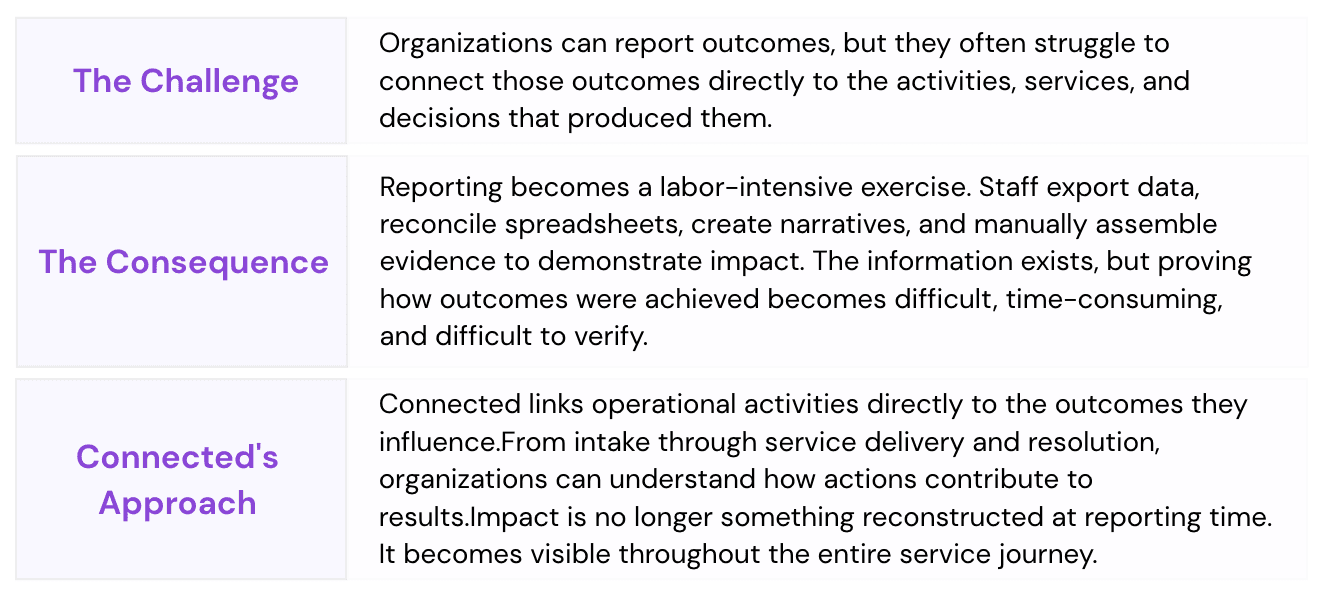
"You cannot demonstrate impact effectively if the work that created it is disconnected from the outcome being measured."
Root Cause 3: AI Is Limited by a Missing Foundation
The emergence of AI has created enormous opportunities for organizations to improve efficiency, coordination, and decision-making. Yet many civic organizations have struggled to move beyond experimentation. The reason is not a lack of interest but a lack of foundation.
AI performs best when it has access to structured information, connected workflows, and clearly defined processes. Unfortunately, fragmented systems and manual workarounds make those conditions difficult to achieve.
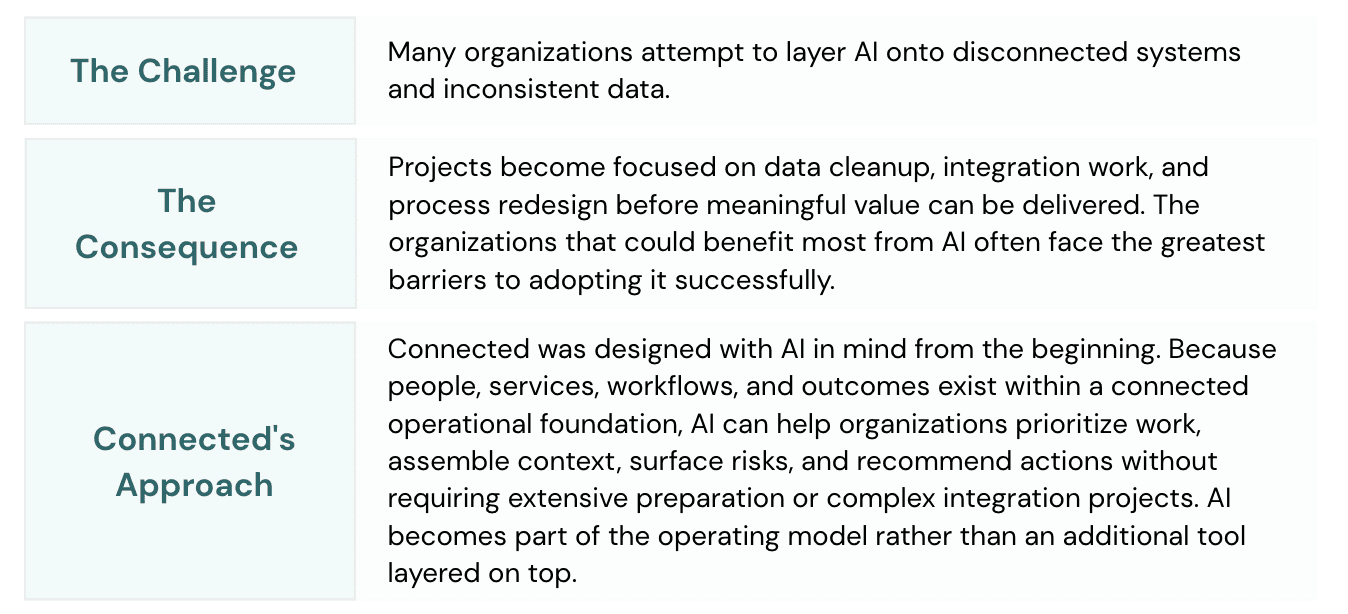
"Civic organizations do not need more AI demonstrations. They need the operational foundation that allows AI to create real value."
Why This Moment Makes the Gap Undeniable
The Civic Operations Gap is becoming increasingly difficult to ignore.
Funders expect stronger evidence of impact and greater accountability for how outcomes are achieved.
Community needs continue to grow while resources remain constrained. Organizations are being asked to deliver services more efficiently, respond more quickly, and demonstrate measurable results.
At the same time, advances in AI are creating new opportunities to increase capacity and reduce administrative burden.
The question is no longer whether organizations should modernize.
The question is whether their operational foundation can support what comes next.
Closing the Gap by Design
The Civic Operations Gap was not created by a lack of dedication, talent, or innovation. It emerged because organizations were asked to deliver increasingly complex services using systems that were never designed for civic work.
For years, organizations adapted. They built workarounds. They connected disconnected systems. They relied on spreadsheets, institutional knowledge, and extraordinary effort from staff.
But adaptation has limits. Closing the gap requires more than adding another tool. It requires a foundation designed around the people, services, programs, and outcomes that define civic work.
A foundation that is purpose-built for the sector.
A foundation that connects operations to outcomes.
A foundation that enables AI to strengthen how organizations work.
That is the foundation Connected was built to provide.
Key Takeaways
The Civic Operations Gap persists because organizations rely on disconnected tools, struggle to connect operational work to outcomes, and lack the foundation needed to fully leverage AI.
These challenges compound one another: fragmented operations make impact harder to demonstrate, and both limit the effectiveness of AI.
Rising accountability requirements, growing community expectations, and advances in AI have made the gap increasingly difficult to ignore.
Connected addresses these challenges through a purpose-built foundation that connects operations to outcomes and enables AI from day one.
The Civic Operations Gap is ultimately a design problem — and solving it requires technology built for this work from the ground up, not adapted from another context.