
Patterns
Civic work depends on making the right decisions at the right time. Connected uses AI to help organizations prioritize what matters most, investigate issues with complete context, and take action with confidence. The result is faster decisions, better coordination, and greater community impact.
Civic work is a continuous stream of decisions.
Which case needs attention first?
Which family is most at risk?
What information is missing?
What action should happen next?
The quality of these decisions shapes every outcome an organization produces. The challenge for these organizations is not commitment, but information.
The signals exist. The need exists. The opportunity exists.
But the information required to act is often scattered across systems, buried in notes, trapped in spreadsheets, or dependent on institutional memory.
This creates a signal-to-action gap. While organizations recognize problems, acting on them takes too long.
The Signal-to-Action Gap
In most civic organizations today, the signal-to-action gap is wide and slow.
A caseworker notices a case becoming overdue.
A program manager sees delays increasing.
A director recognizes a growing operational risk.
Each observation represents a signal. But turning that signal into action often requires significant manual effort to gather information, assemble context and coordinate actions. Friction points in each stage of that process further widen the gaps.
Prioritization - Organizations are constantly balancing urgency, volume, complexity, and risk. Without support, prioritization becomes dependent on individual experience and limited visibility.
Investigation - Staff has to search multiple systems, emails, documents, and reports simply to understand what is happening.
Actions - Most systems identify a problem, generate a report, or trigger an alert, and then shift the responsibility back to staff to figure out what happens next.
By the time the process is complete, valuable time has been lost.
The gap between recognizing an issue and resolving it is often the difference between timely support and missed opportunities.
“The gap between recognizing an issue and resolving it is the gap between a community member getting help and falling through the cracks.”
AI That Works When the Foundation Is Right
AI working on the right foundation closes the signal-to-action gap.
Prioritize
AI can continuously monitor operational activity and surface what requires attention - cases approaching deadlines, emerging service bottlenecks, increasing workloads or potential escalation risks.
The result is not simply more alerts. It is a clearer focus as teams begin each day understanding where attention will create the greatest impact.
Investigate
Once priorities are identified, context becomes critical. AI can assemble the relevant information by searching through history, services delivered and related cases in the context of the program.
Investigation becomes faster because staff spend less time gathering information and more time understanding it. Instead of asking people to remember everything, the system brings together what they need when they need it.
Act
AI can continue beyond insight into execution through recommendations that help guide decisions, agents that automate routine tasks and workflows that coordinate activities across teams.
Actions are tracked and connected directly to outcomes delivering better visibility and consistent outcomes.
Connected is purpose-built to make AI work
Connected's purpose-built architecture provides clean structured data, role-aware workflows, and governance to make AI work without a data cleanup project.
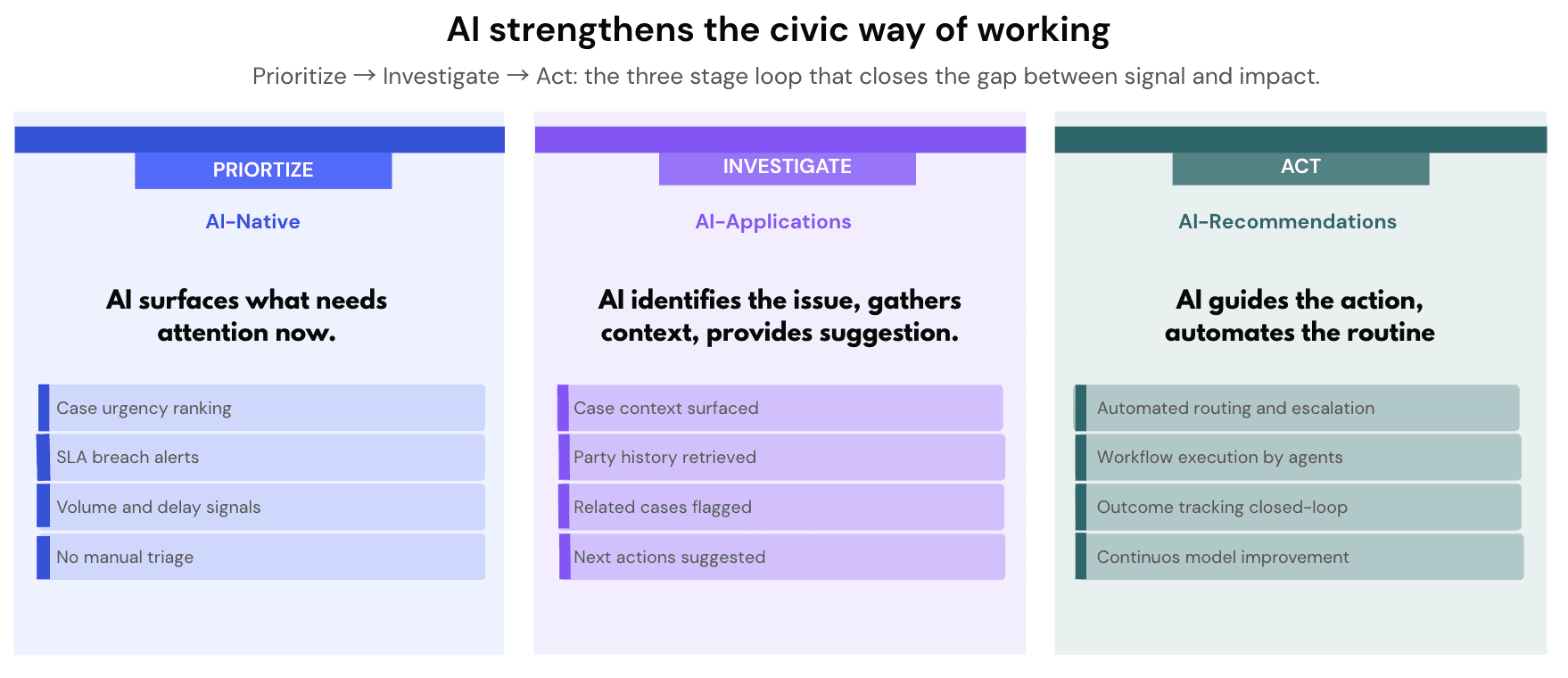
01 — Prioritize: AI-Native Urgency Surfacing
AI-native foundation continuously monitors the operational landscape and surfaces what needs attention before it becomes a crisis.
02 — Investigate: AI-Built Applications for Context
AI-built applications retrieves and assembles the context needed to support end-to-end workflows from intake to resolution, collaborating with caseworkers so they can focus their expertise where it matters most.
03 — Act: AI-Driven Outcomes and Recommendations
AI-driven outcomes layer guides, automates, and tracks actions taken in response to what was prioritized and investigated, ensuring accountability from intervention to outcome.
Prioritize → Investigate → Act is not a workflow. It's a loop. Each cycle makes the next one faster, more accurate, and more impactful. |
A Stronger Way of Working
AI is valuable because it helps people focus their expertise where it matters most. When the foundation is right, organizations spend less time searching, coordinating, and administrating and more time on the mission.
As every cycle becomes more informed, it becomes faster and more impactful than the one before. That is what happens when technology is designed around the way work actually gets done.
Key Takeaways
The signal-to-action gap — from recognizing an issue to resolving it — is the gap between a community member getting help and falling through the cracks.
AI closes this gap only when it has clean data, structured workflows, and defined roles. Connected's purpose-built architecture provides this from day one.
Prioritize (AI-Native) surfaces what matters most — urgency, delay, and volume — automatically, without manual triage.
Investigate (AI-Applications) assembles the context — history, related cases, service options — in one AI-composed view.
Act (AI-Recommendations) guides the decision, automates the routine, and tracks the outcome — closing the loop and improving the next cycle.