
Platform
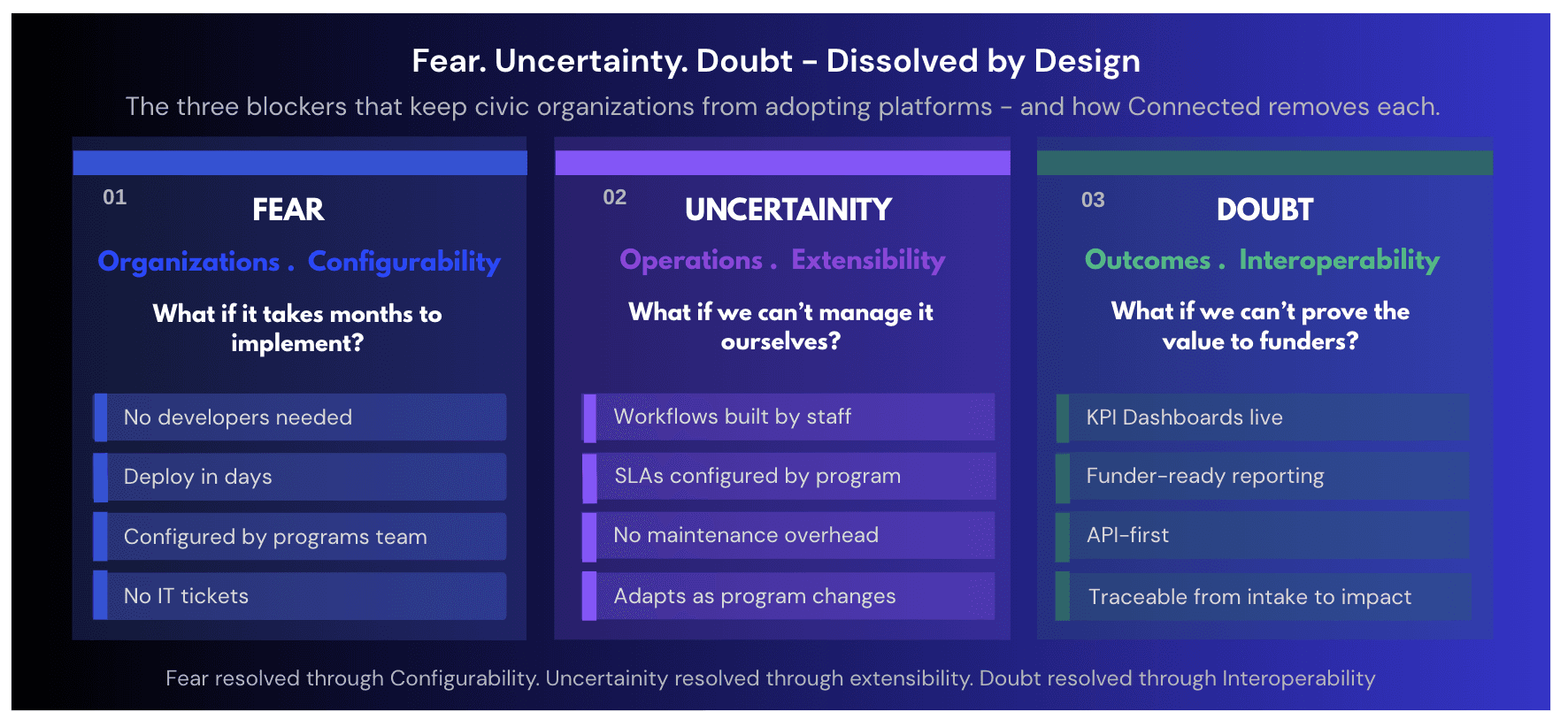
Even when organizations recognize the need for change, fear of implementation effort, uncertainty about ongoing management, and doubt about measurable value often prevent action. These are not irrational concerns—they are the result of years of difficult technology experiences. Connected was designed to remove these barriers through simplicity, adaptability, and measurable outcomes.
Even when civic organizations recognize the need for better infrastructure, many still struggle to move forward. This hesitation is often misunderstood as a resistance to change, or a lack of innovation, and maybe even a lack of ambition.
None of it is true.
It is their own experience.
Years of difficult implementations, expensive consulting engagements, disappointing software investments, and operational disruptions have created three very rational concerns:
Fear. Uncertainty. Doubt.
Until those concerns are addressed, adoption remains difficult regardless of how promising a solution appears.
Fear: What If We End Up Right Back Where We Started?
Fear rarely comes from technology itself. It comes from experience.
Organizations have seen projects stretch from months into years.
They have invested limited grant funding into systems that never delivered expected results.
They have asked staff to change the way they work only to discover that adoption remained low and reporting remained difficult.
The real fear is not implementation. The real fear is spending valuable time, money, and organizational energy without creating meaningful improvement. For organizations responsible for critical community services, that risk feels enormous.
Uncertainty: Can We Sustain It?
Even when a platform is successfully deployed, another concern emerges.
Can we actually manage it?
Most civic organizations do not have dedicated platform administrators. Few have development teams. Many rely on a small group of staff members who already wear multiple hats.
What happens when programs evolve?
What happens when reporting requirements change?
What happens when the employee who understands the system leaves?
These questions create uncertainty long after implementation is complete.
Doubt: Will It Actually Improve Outcomes?
The final blocker is often the most difficult to overcome. Organizations have seen platforms generate activity without generating value.
Data gets entered.
Reports get created.
Dashboards get built.
Yet leadership still struggles to answer a simple question:
Has this actually improved our ability to serve the community?
If the answer remains unclear after significant investment, technology becomes another obligation rather than an operational advantage.
“Fear of effort. Uncertainty about management. Doubt about value. Three rational responses to irrational tools — dissolved by a platform designed differently.”
Designing for Reality
These concerns did not emerge because organizations are reluctant to innovate. They emerged because the systems available to them often failed to match their operational reality.
That reality shaped Connected from the beginning.
If programs cannot adapt to the platform themselves, the platform creates dependency.
If operations cannot evolve without technical intervention, the platform creates friction.
If outcomes cannot be measured and traced back to services delivered, the platform creates uncertainty.
Those were not constraints. They became the design brief.
01 — Organizations: Configurable by Design
Connected's organizational layer was built around a single principle: the team running the program should be able to configure the platform that supports it — without a developer, without an IT ticket, and without waiting.
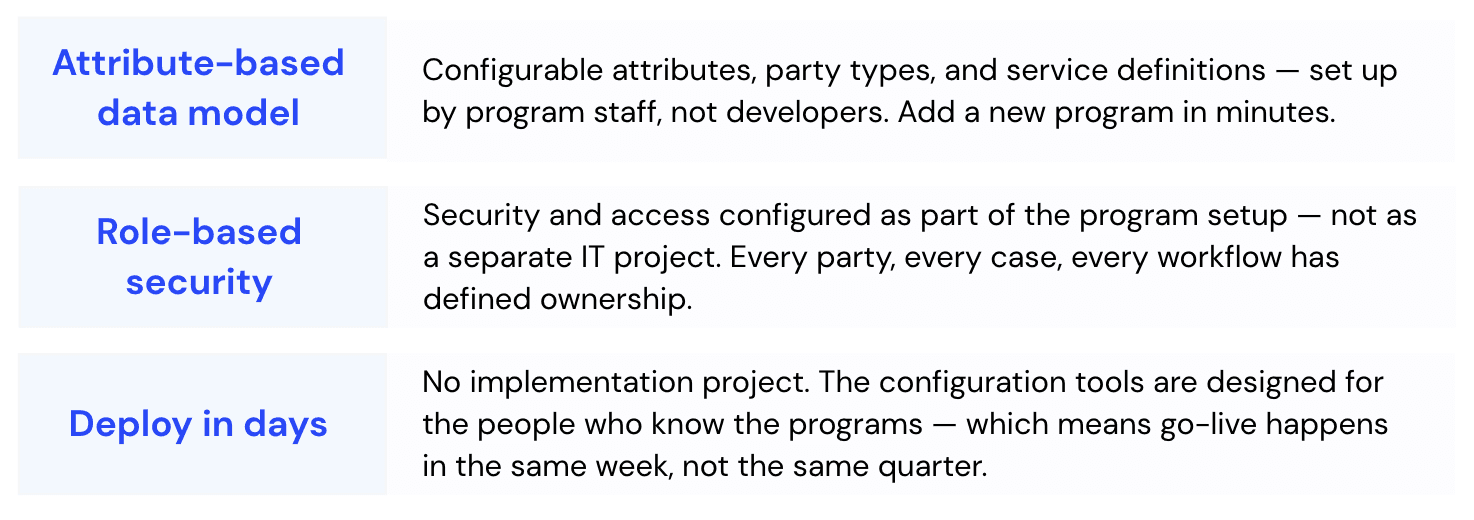
The fear of implementation effort disappears when the team running the program can configure the platform themselves — in days. |
02 — Operations: Extensible Without IT
The operational layer of Connected was designed for the reality of civic organizations: programs change, teams change, community needs change. A platform that requires IT involvement for every adaptation is a platform that will fall behind the programs it's meant to support.
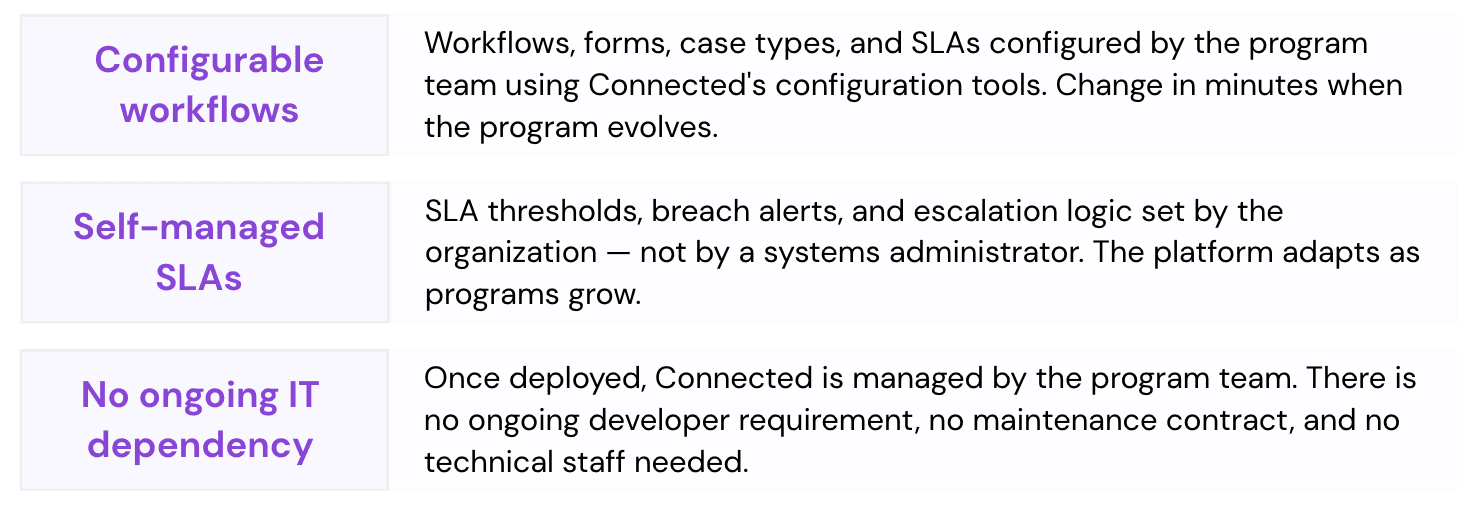
The uncertainty about ongoing management dissolves when the platform is designed to be run by the people running the programs — not the IT department. |
03 — Outcomes: Interoperable Proof
The outcomes layer of Connected was designed for the world civic organizations actually operate in: funders who require structured reporting, regulators who demand traceability, boards who need dashboards, and partner agencies who need to exchange data.
The doubt about demonstrable value dissolves when outcomes are measurable, trackable, and traceable — from intake to community impact, in real time. |
What Changes When the Platform Fits
When organizations can adapt the system themselves, fear begins to disappear.
When programs can evolve without technical bottlenecks, uncertainty begins to disappear.
When outcomes can be measured, tracked, and demonstrated, doubt begins to disappear.
The goal is not simply better software. The goal is confidence.
Confidence that technology can support the mission instead of distracting from it.
Confidence that systems can evolve alongside programs.
Confidence that investments can produce measurable community impact.
Only then can organizations focus their attention where it belongs: serving people.
Key Takeaways
Fear, Uncertainty, and Doubt are rational responses to years of painful enterprise technology experiences.
Fear of implementation effort is dissolved by Configurability: the program team deploys in days without developers.
Uncertainty about ongoing management is dissolved by Extensibility: workflows adapt without IT tickets.
Doubt about demonstrable value is dissolved by Interoperability: outcomes are measurable, trackable, and traceable in real time.
Connected's Platform layer (Organizations, Operations, Outcomes) was designed to make each of these fears baseless — by architecture, not by exception.