
Technology has transformed nearly every sector over the past two decades. Organizations can automate workflows, predict demand, personalize experiences, and make decisions faster than ever before.
Yet many of the organizations doing the most important work in our communities still rely on spreadsheets, disconnected systems, and institutional memory. Not because they resisted technology or lacked vision, but because the technology available to them was never designed for the way they work.
A housing navigator spends more time updating systems than helping families. A food assistance coordinator exports data into spreadsheets to satisfy funder reporting. A program manager maintains shadow processes because the official system cannot adapt quickly enough.
These aren't isolated frustrations. They are symptoms of a structural problem that has constrained the civic sector for decades.
Space: Technology built for someone else's operating model.
Time: Systems that require months of preparation before they can deliver value.
Value: Costs that force organizations to choose between infrastructure and mission.
The Three Structural Barriers
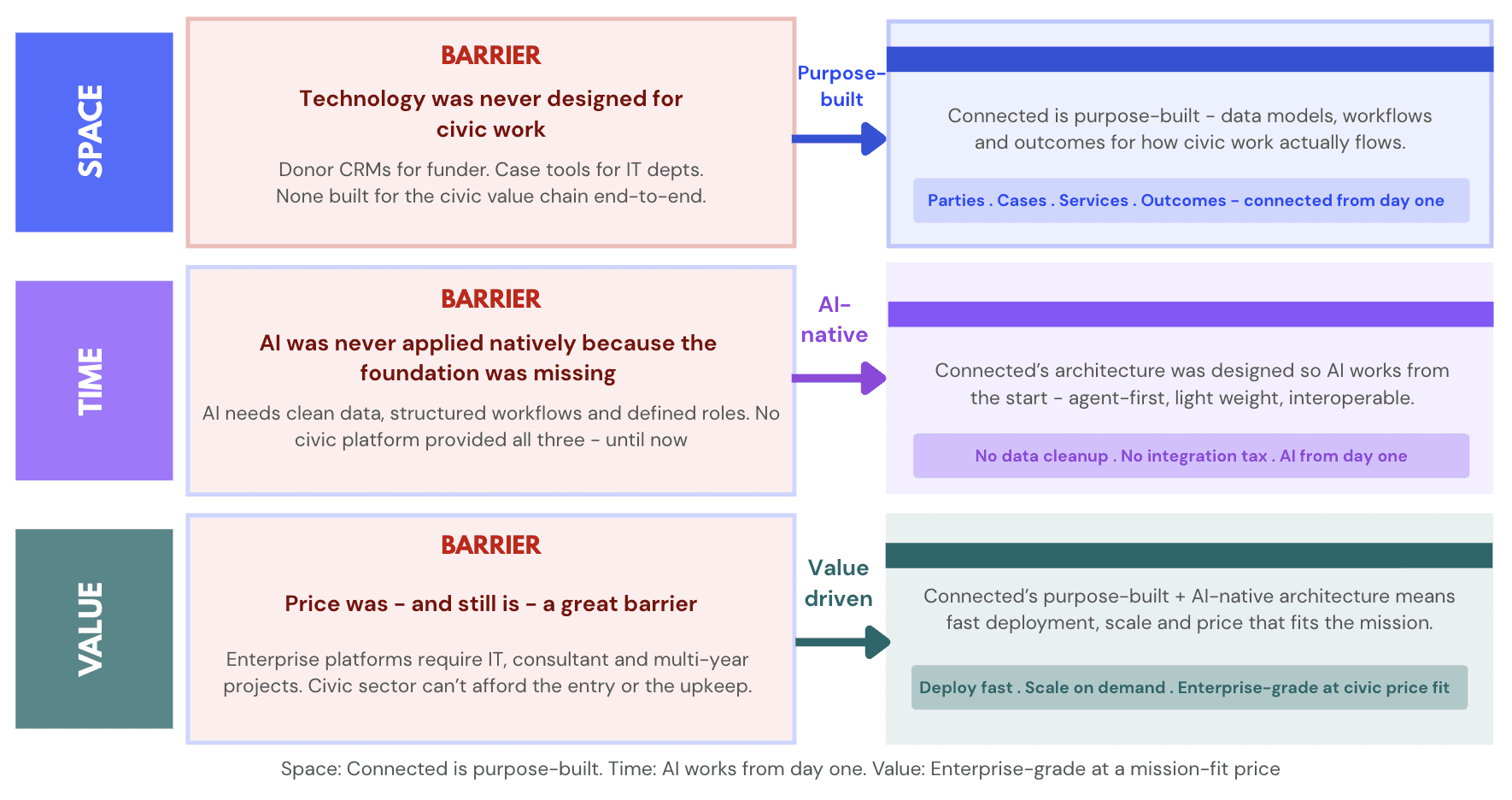
Space: Technology Built for someone else
Most enterprise software was designed for industries with large technology budgets, dedicated IT teams, and highly standardized processes. The civic sector operates differently. Organizations must adapt constantly to changing community needs, evolving funding requirements, and complex service delivery environments.
Yet the tools available to them have largely been adaptations of systems built for other industries.
Donor management systems were designed primarily around fundraising.
Case management platforms often require technical specialists to maintain.
Generic workflow tools demand extensive customization before they become useful.
The result is that organizations spend years adapting themselves to software instead of software adapting to them.
“The sector was given tools designed for someone else's problems — and asked to make them work for theirs.”
Time: AI Arrived, But Not For the Civic Sector
The conversation around AI has accelerated dramatically. But most civic organizations have discovered the same reality.
AI is only as useful as the systems beneath it.
When data is fragmented across spreadsheets, disconnected applications, emails, and institutional knowledge, AI struggles to produce meaningful results. The challenge isn't that civic organizations lack access to AI, but that they were never given the operational foundation AI requires.
Clean data. Structured workflows. Connected records. Defined processes.
Without these elements, AI becomes another tool that promises transformation but delivers limited value.
Value: The Mission Economics Problem
The civic sector has always faced a difficult tradeoff.
—The systems powerful enough to transform operations were often priced for enterprise organizations.
—The systems affordable enough for civic organizations often created more fragmentation than they solved.
Every dollar spent on infrastructure competes with dollars spent on programs, services, and community impact. As expectations continue to rise—from funders, regulators, boards, and communities—the cost of inadequate infrastructure grows larger every year. Organizations are being asked to do more with less while operating on systems that were never designed for the work they perform.
The Moment This Became Undeniable
The three forces converged to make the civic technology gap impossible to ignore. Funders began requiring proof of outcomes — not narratives, but measurable, trackable data. Communities began demanding faster, more reliable services. And the pandemic exposed just how fragile civic infrastructure had become when organizations that ran on spreadsheets and institutional memory suddenly couldn't be in the same room.
The organizations most essential to civil society — nutrition, housing, health, education, financial stability — were running on the least capable infrastructure. The gap between what was asked of them and what their tools could support had never been wider.
Connected: Purpose-Built for the Space
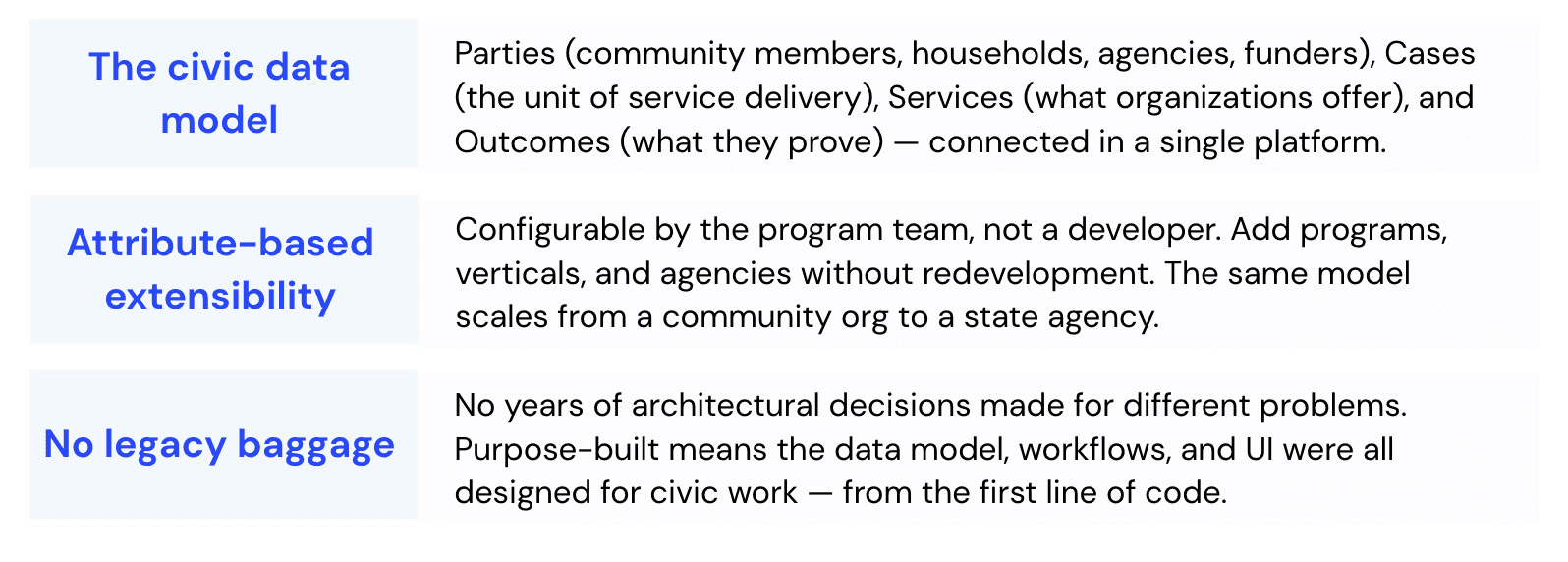
01 — Purpose-Built: Designed for the Civic Space
Connected was not adapted from an enterprise CRM or a generic workflow platform. It was designed from the ground up around the civic data model: parties, cases, services, and outcomes — the four objects that represent how civic work actually flows.
02 — AI-Native: The Time Advantage
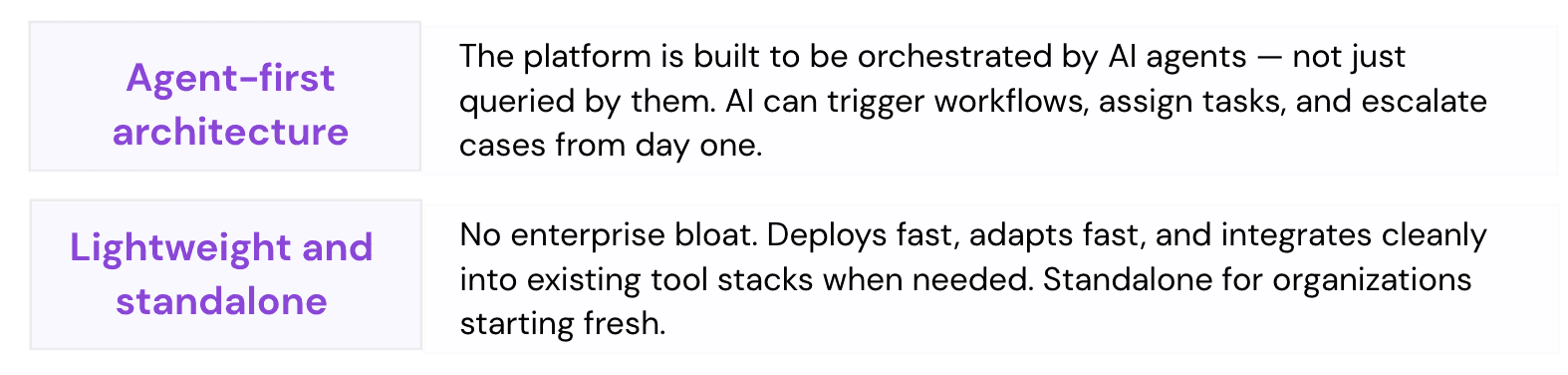
AI works on clean data, structured workflows, and defined roles. Most civic platforms can't provide any of those things — which is why AI "features" bolted onto legacy systems consistently fail in the civic sector. The data isn't clean. The workflows aren't defined. The roles aren't structured.
Connected's architecture was designed so AI has everything it needs from the moment you go live. No data cleanup project. No integration tax. No bolt-on configuration.
“AI was never applied natively to the civic sector because no platform provided the clean civic data model AI needs. Connected was built to change that.”
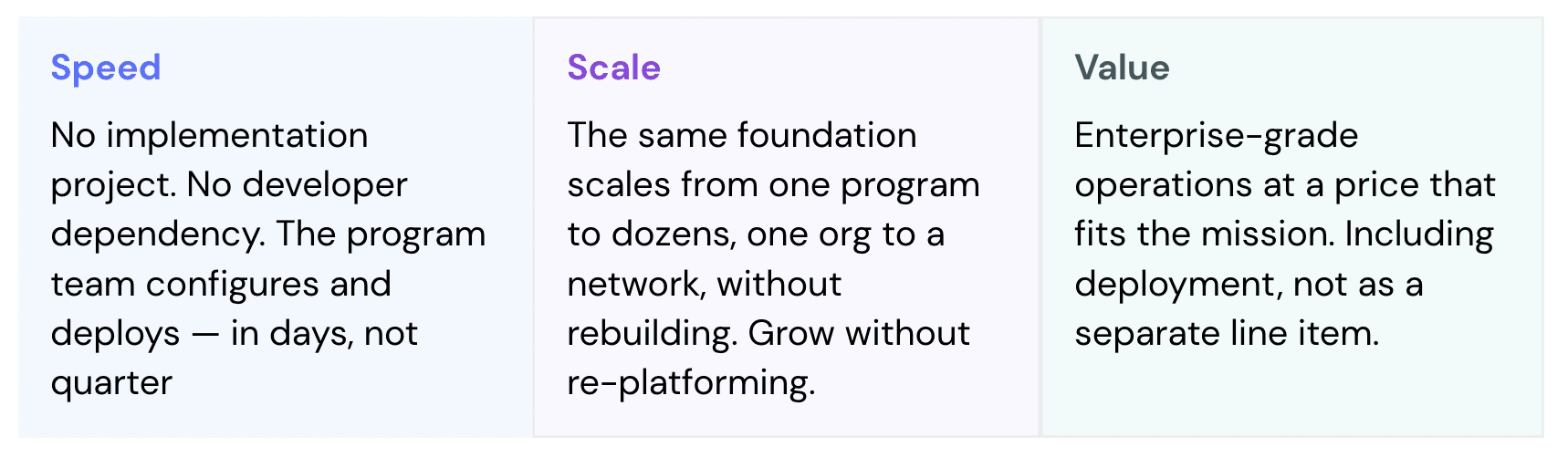
03 — Speed, Scale, Cost: The Value Equation Rebalanced
The civic sector has always faced a price paradox: the tools that could genuinely transform operations were priced for enterprise budgets, while the budget-friendly tools created the operational fragmentation they were meant to solve.
Connected's purpose-built + AI-native architecture collapses this paradox:
Space: purpose-built. Time: AI works from day one. Value: enterprise-grade at a mission-fit price. The three structural barriers — dissolved by design. |
A Different Foundation
The answer to overcome these structural barriers is infrastructure designed around the realities of civic work, the constraints of mission-driven organizations, and the outcomes communities depend on.
Purpose-built for the space. Ready for AI from day one. Accessible at a mission-fit cost.
That is the foundation Connected was built to provide.
Key Takeaways
The civic sector has been left behind by three structural barriers: technology built for the wrong space, AI never applied natively, and pricing that was never accessible.
Connected is purpose-built — the data model, workflows, and UI were all designed for how civic work actually flows.
AI-native architecture means AI works without prep: no data cleanup, no integration tax, effective from day one.
The Speed, Scale, Cost advantage flows directly from the purpose-built + AI-native foundation — not from discounting.
The 'Space. Time. Value.' problem is structural. The solution has to be architectural — not cosmetic