
Patterns
Native. Application. Acceleration. The three AI patterns that make the difference — and why most platforms only offer the promise.
Every software vendor has an AI story now. Dashboards have AI. Case systems have AI. Even spreadsheet replacements have AI. For civic organizations, this proliferation of "AI features" has created a new version of an old problem: tools that promise transformation and deliver complexity.
The reason most AI implementations fail in the civic sector isn't the AI itself. It's the foundation underneath it. AI works on clean data, structured workflows, and defined roles. Most platforms in the civic sector can't provide any of those things, even when the technology exists, because their architecture was never designed for it.
Connected was built differently. Not AI added to a platform. A platform designed so AI works throughout the journey from the moment you go live, across every program you run, and at every scale you operate.
The Problem With "Just AI"
Nonprofits want to embrace AI, but they’re facing the same questions as every other organization: How do we get meaningful insights from it? Can it actually reduce day-to-day workload? Can we trust it with sensitive information?
This is the bolt-on problem. AI layered onto a legacy foundation rarely delivers meaningful value because of the fragmented systems, disconnected workflows, and incomplete context it has to work with.
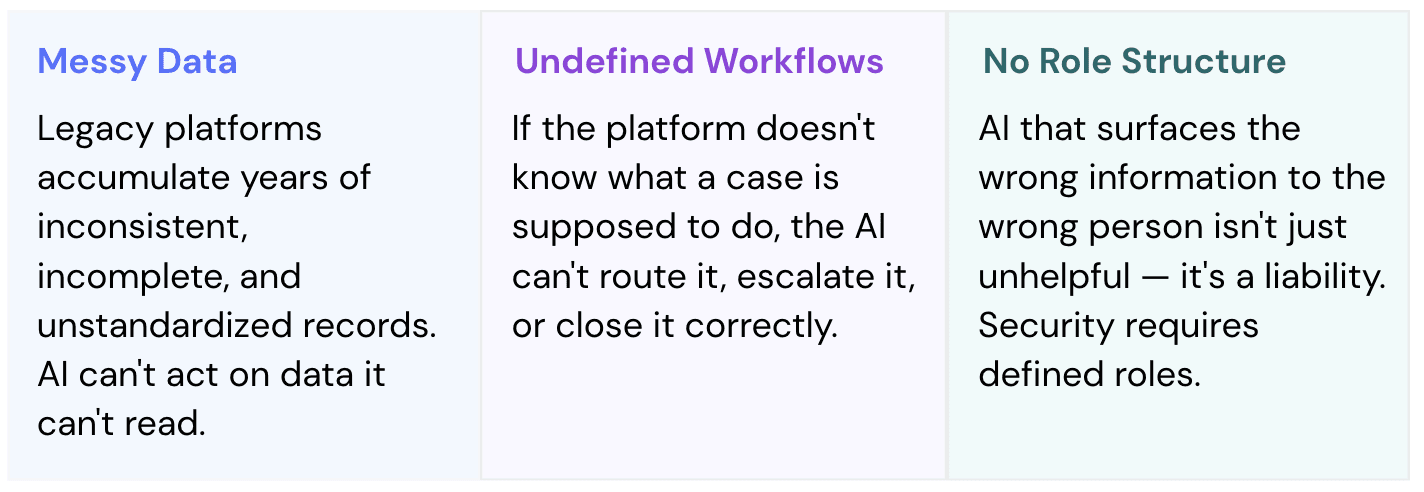
“Most platforms bolt AI on after the fact. Connected was designed from the ground up so AI has what it needs to work.”
For civic organizations, the cost of the bolt-on problem is particularly acute. Limited budgets mean there's no margin for a year-long data cleanup project before AI can be turned on. Limited staff means there's no capacity to manage complex integration tax. And the organizations being served — community members navigating housing, food security, health, and safety — can't wait for the technology to catch up.
The Foundation That Makes AI Work
Connected's AI capabilities aren't features. They're the expression of an architectural decision made before a single line of product code was written: build the data model first, and let the AI work with it.
The platform is organized around three layers — Business (parties, services, outcomes), Platform (configurable, extensible, interoperable), and AI. Each layer is designed to feed the next. By the time AI enters the picture, it already has everything it needs:
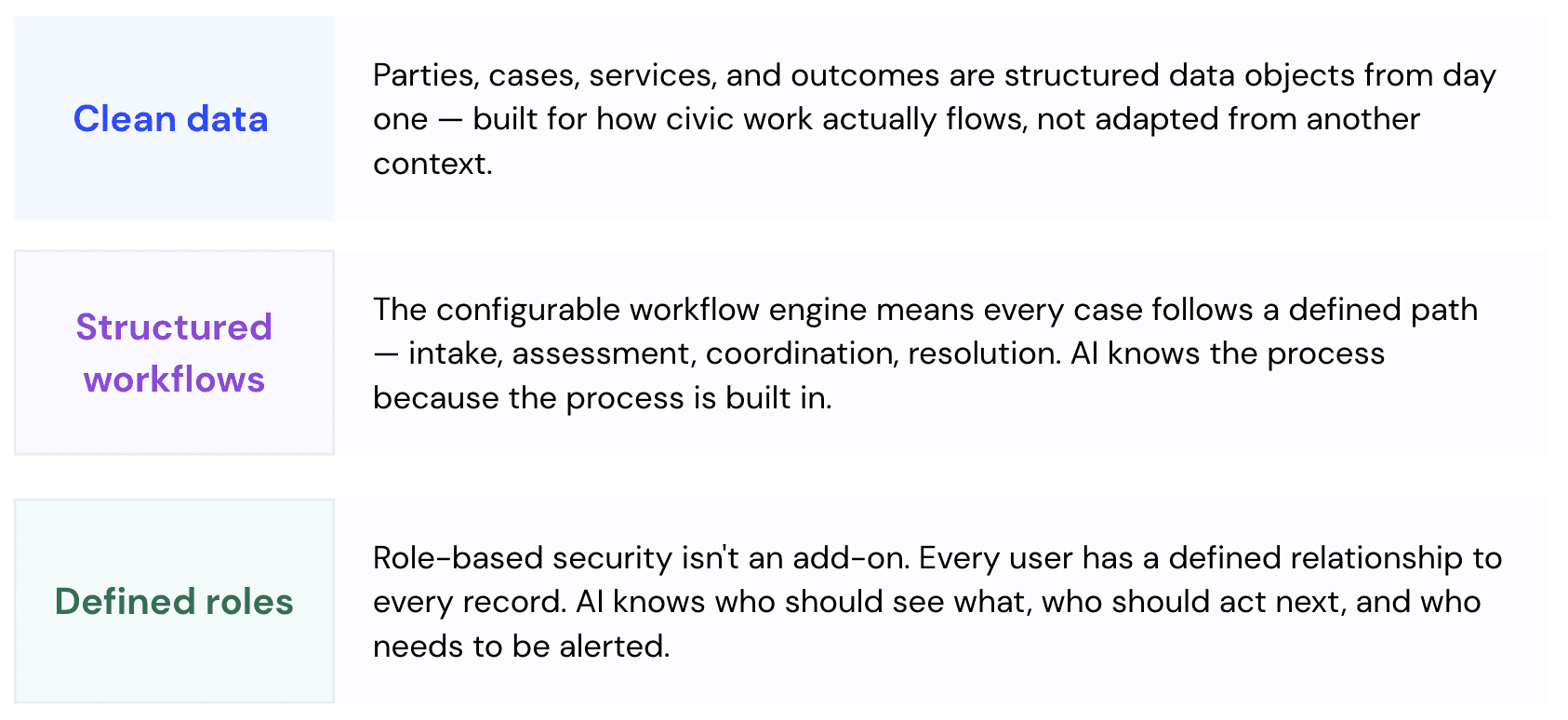
With this foundation in place, three AI patterns become possible — and each one builds on the last.
The Three AI Patterns
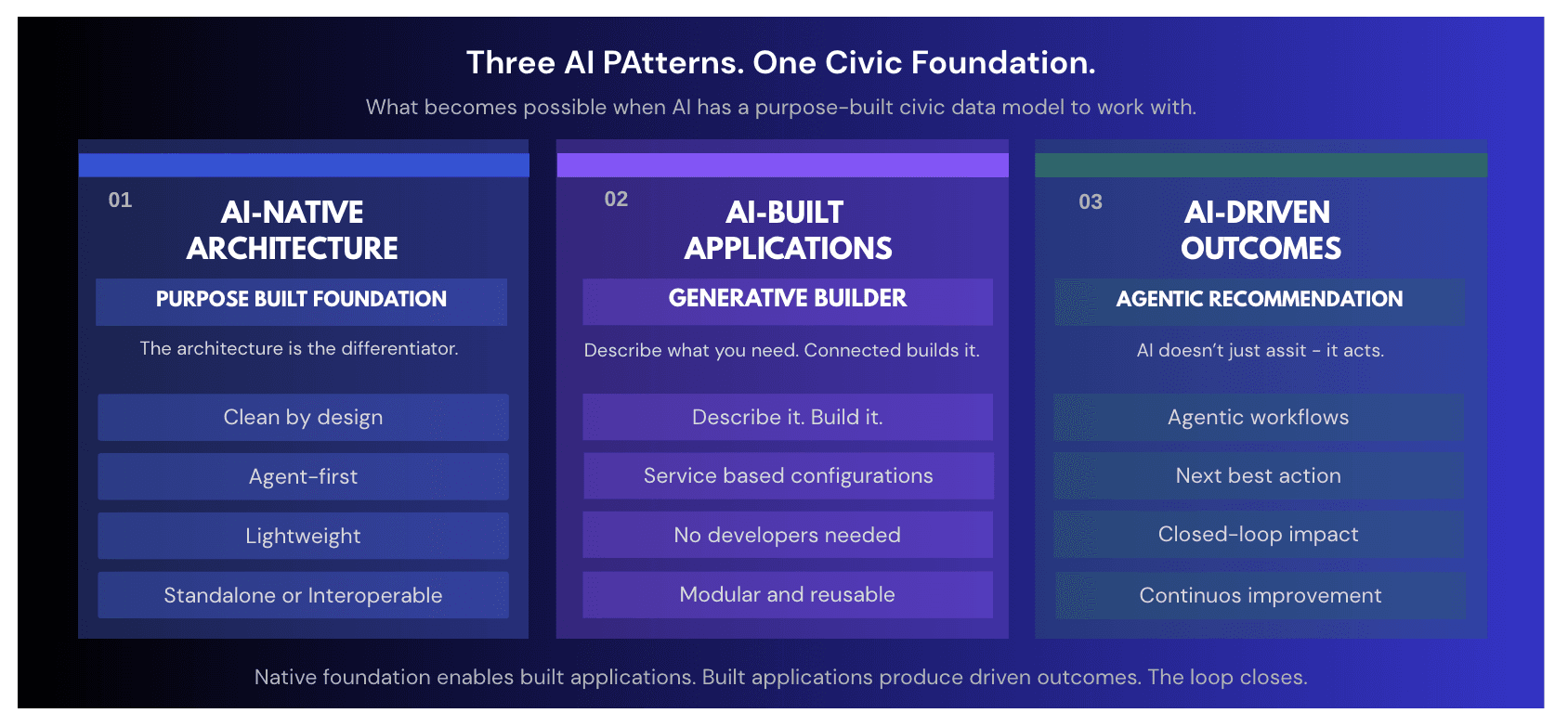
01 — AI-Native Architecture: The Purpose-Built Foundation
The first pattern isn't a feature you turn on. It's the reason everything else works.
Connected's architecture is lightweight and agent-first. It was designed to be orchestrated by AI — not just used by it. That means the platform can receive instructions from AI agents, execute workflows on their behalf, surface results back to staff, and hand off to humans when judgment is required.
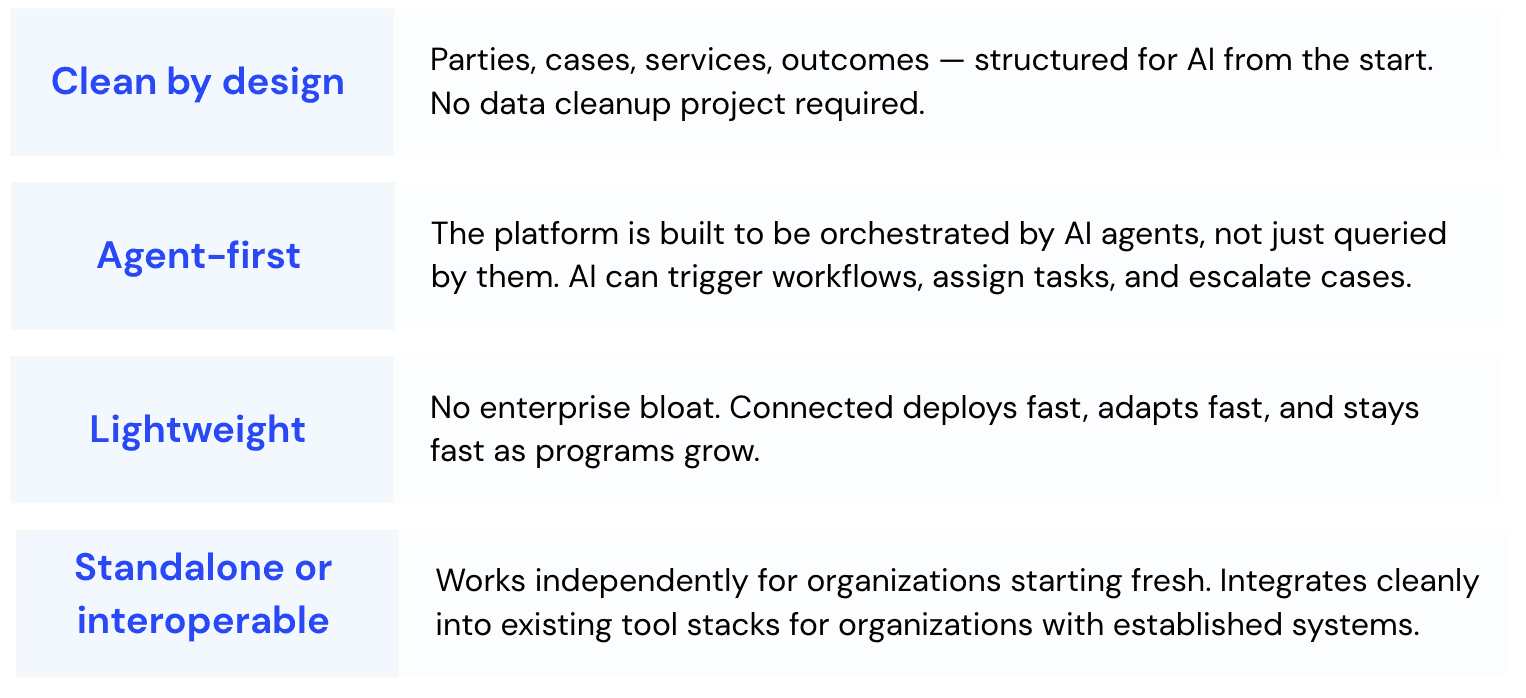
“Connected isn't a legacy platform with an AI layer — it was designed around clean structured data, role-aware workflows, and defined relationships.”
02 — AI-Built Applications: Generative · Builder
The second pattern is where the foundation becomes visible.
The generative app builder lets civic organizations create and deploy service applications — intake forms, case workflows, coordination tools, assessment templates — without a developer or an implementation project. Describe what the program needs. Connected builds it.
This isn't a template library. It's a generative system that uses Connected's data model to build applications that are already connected to the right parties, cases, services, and outcomes. An intake form built by the app builder doesn't just collect data — it creates a case, assigns it to the right worker, starts the right workflow, and surfaces it in the right dashboard.
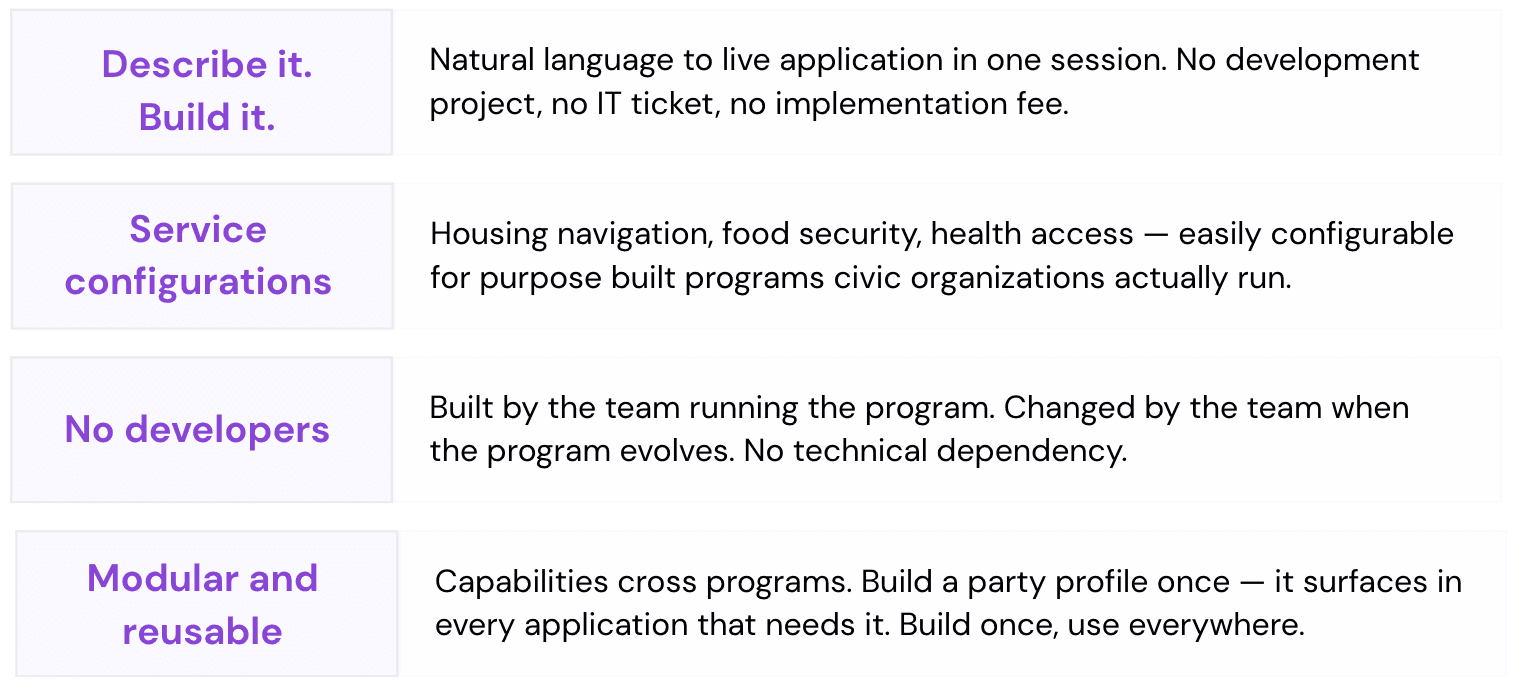
“Describe what you need. Connected builds it. The generative app builder lets organizations create and deploy service applications without long development cycles or an implementation project.”
03 — AI-Driven Outcomes: Agentic · Recommendation
The third pattern is where AI stops assisting and starts acting.
Connected's agentic layer uses the structured foundation of the platform so workflows can be built to run autonomously — handling case triage, routing escalations, flagging SLA breaches, and surfacing next best actions for staff. The result isn't just efficiency. It's traceability: every action the AI takes is recorded, auditable, and connected to the outcome it produced.
As the platform evolves, AI evolves with it.
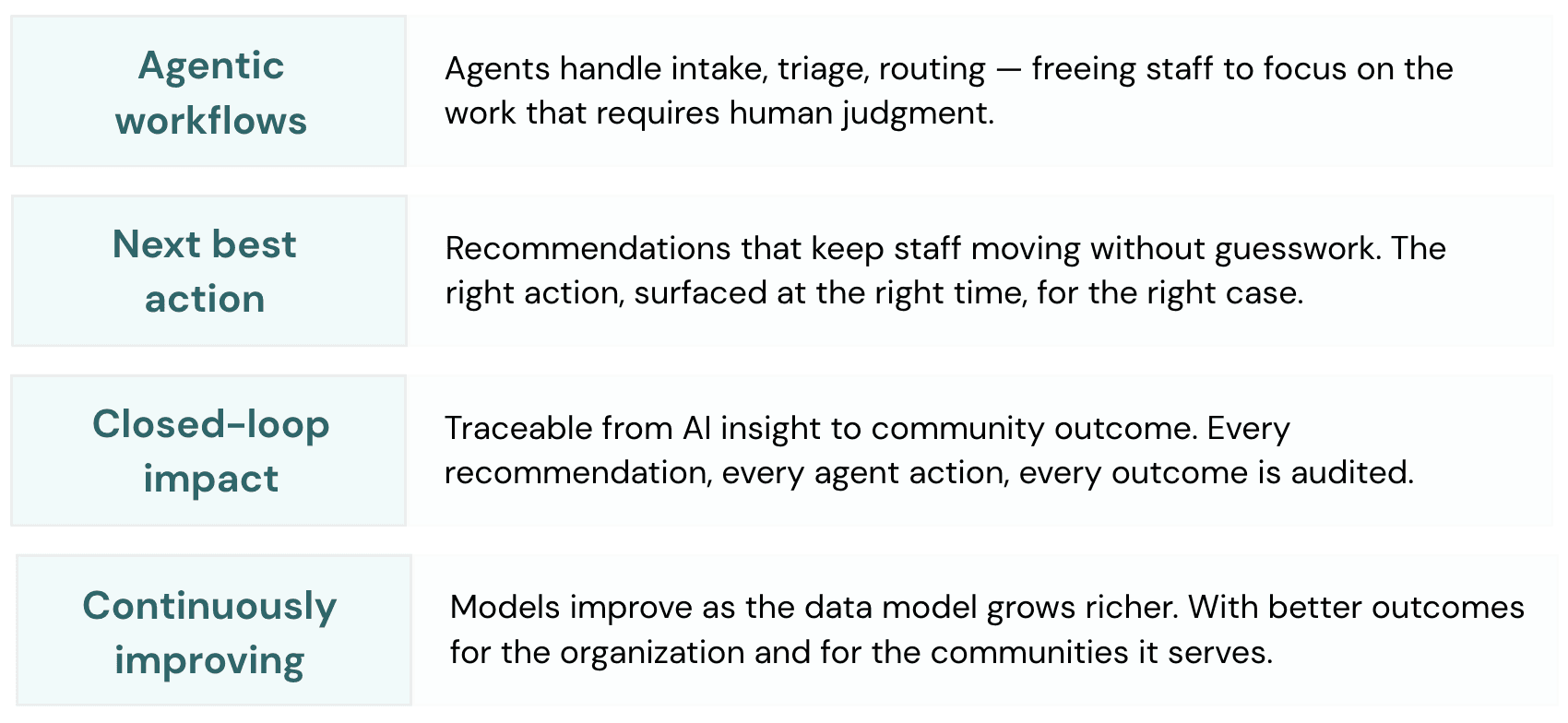
“AI doesn't just assist — it acts. Agents handle case triage, escalations, and coordination. Recommendations surface what staff should do next. The result: faster operations, lower overhead, and outcomes that are traceable all the way to the community.”
How the Three Patterns Connect
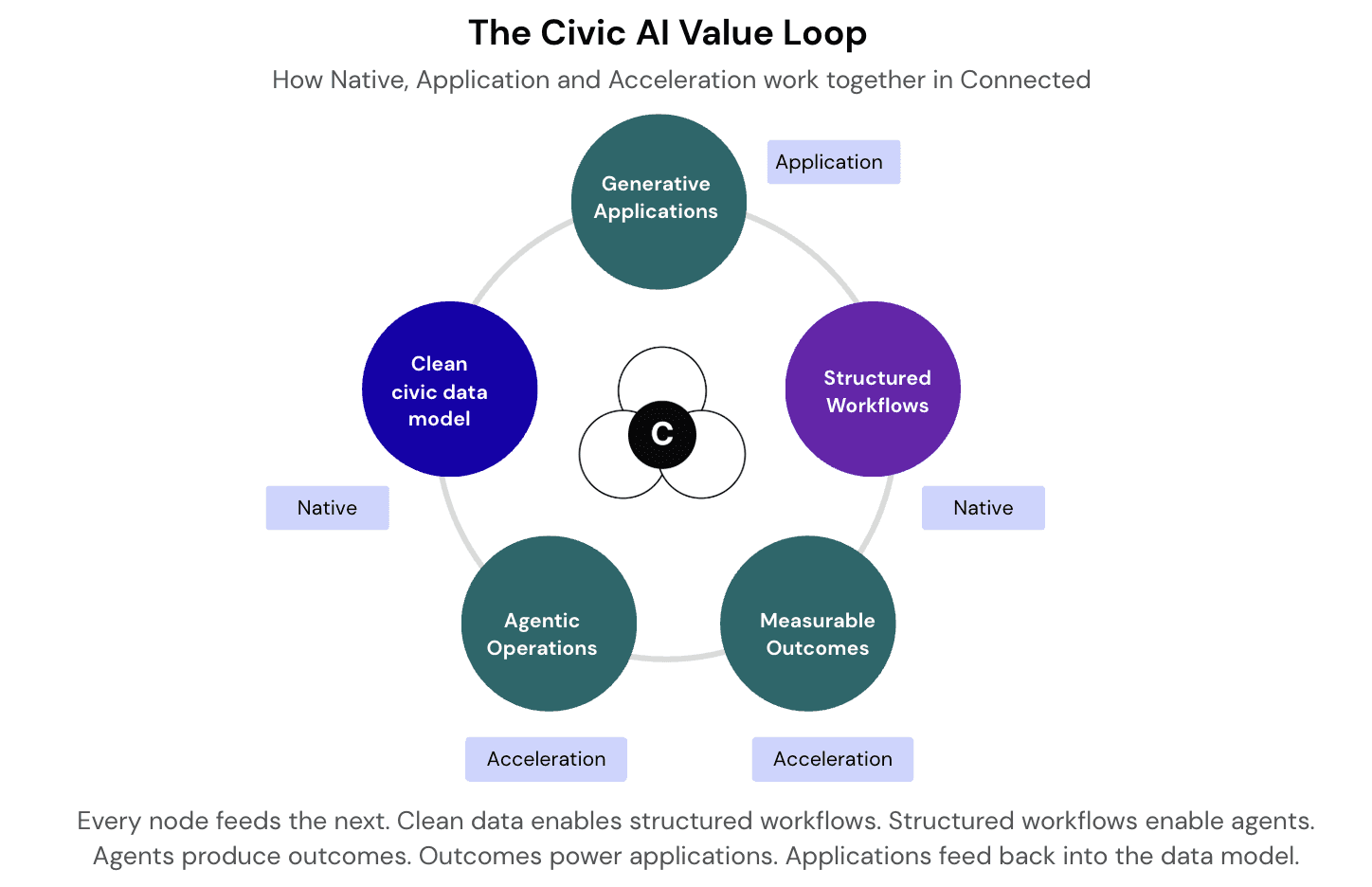
The three patterns aren't independent capabilities. They're a loop.
The Native foundation provides clean data and structured workflows. Those structures enable the Application pattern — the generative builder has everything it needs to create applications that actually work. Those applications run on the platform, generating the structured operational data that feeds the Acceleration pattern. Agents and recommendations act on that data, producing outcomes. Those outcomes feed back into the data model — enriching it, improving the AI, and closing the loop.
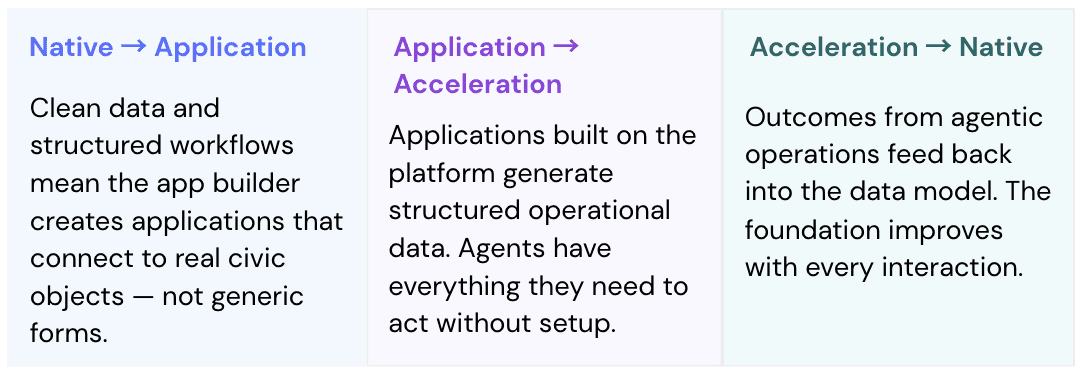
This is why the distinction between "just AI" and Connected's three patterns matters. A bolt-on AI feature can't improve because it doesn't own the data loop. Connected's AI improves continuously because the Native foundation, the Application layer, and the Acceleration layer are all part of the same system.
What This Means for Civic Organizations
For a nonprofit program director, this means deploying a new housing intake application in a single session — not a six-month project.
For a caseworker, it means AI that flags the cases that need attention today and recommends the right next action — not a dashboard that requires interpretation.
For a program leader, it means outcomes that are measurable, trackable, and traceable — ready for funder reports, board presentations, and grant renewals — without a manual data export.
For a city agency, it means the same platform that serves a single program today can coordinate dozens of programs, hundreds of staff, and hundreds of thousands of community members tomorrow — on the same data model, without rebuilding.
“The organizations with the greatest impact on civil society have the least infrastructure to show for it. Connected was built to change that — and AI is how the change becomes visible.”
Native. Application. Acceleration. Not three features. Three commitments to a civic sector that has always deserved better infrastructure — and finally has a platform built to deliver it.
Key Takeaways
Bolt-on AI fails because it lacks the clean data, structured workflows, and defined roles it needs to work.
AI-Native Architecture means Connected was designed so AI works from day one.
AI-Built Applications lets civic teams create service applications in natural language, without developers.
AI-Driven Outcomes closes the loop — agents act, outcomes are traceable, and models continuously improve.
The three patterns are a loop, not a list. Each one feeds the next. The system improves with every interaction.