
Platform
Three failures compounding daily across the civic sector. How parties, cases, and services create the backbone of community impact — and what happens when they're disconnected.
The organizations doing the most important work in civil society — enabling nutrition, education, health, housing, and financial equity — have been handed the least capable infrastructure to do it with. Because the tools that have been handed to them were built for someone else.
The tools available were built for one dimension of the work — fundraising, scheduling, or case tracking in isolation. None of them were built for the full arc of civic work: understanding who you serve, coordinating the work of serving them, and proving the impact of that service.
The result is three compounding failures — one in how civic organizations understand the people and communities they serve, one in how they run their day-to-day operations, and one in how they account for and prove their outcomes. Each failure makes the others worse. Together, they represent the civic operations gap.
Part One: Why Current Tools Fail Civic Organizations
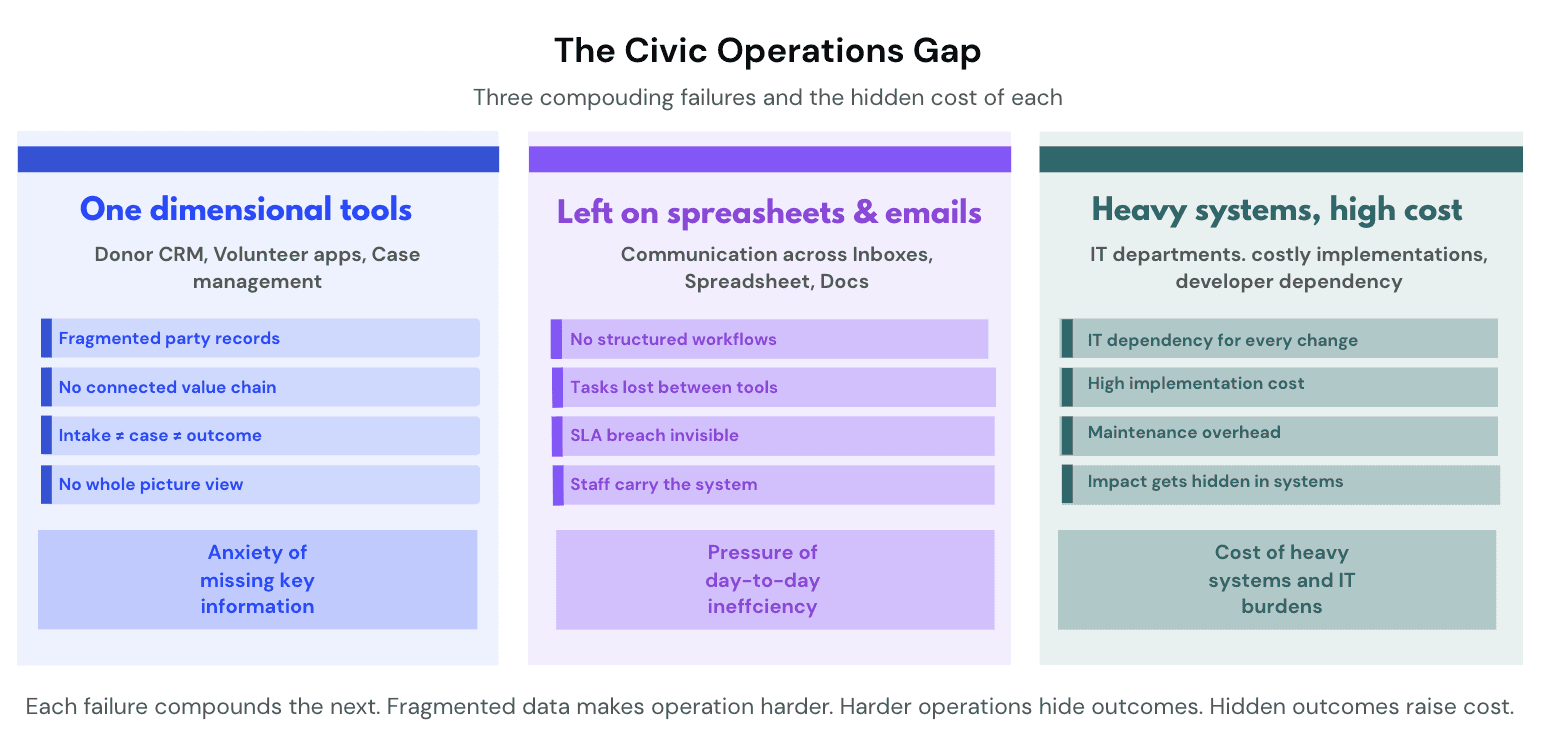
Organizations: One-Dimensional Tools, a Broken Value Chain
Every civic organization serves a connected web of parties: community members, caseworkers, volunteers, partner agencies, funders, and program staff. Their relationships, histories, and interactions form the civic value chain — the living system through which services flow from intake to impact.
But the tools most organizations use were built for one dimension of that chain, not the whole of it:
Donor CRMs - Track funders and donation history. Built for fundraising, not service coordination across community members, cases, and service delivery.
Volunteer Platforms - Manage scheduling and hours. No connection to the cases being served or the outcomes being produced. Activity without context.
Case Systems - Track individual cases in isolation. No relationship to program structure, party history, or funder reporting. Cases without a chain.
The result is a fragmented picture of intake data disconnected from case history, case history disconnected from outcomes, outcomes invisible to the funders who need to see them. Staff spend more time reconciling systems than serving communities.
“The anxiety of missing key information — not because the data doesn't exist, but because no system connects it.”
Operations: Left on Spreadsheets, Email, and Shared Docs
Nonprofit program teams often struggle to coordinate day-to-day work across countless email threads, shared documents, and spreadsheets. Over time, coordination bottlenecks form around a few key individuals trying to hold everything together using systems that don’t actually support how civic work flows.
The operational reality for most civic organizations:
No structured workflows — intake forms, case assignments, task coordination, and follow-ups managed manually across tools with no enforcement, no visibility, and no SLA awareness
Tasks lost between systems — handoffs that happen in email rather than structured records, creating invisible gaps that only surface when something goes wrong
Staff carry the system — institutional knowledge held by individuals rather than by the platform, making every departure a data loss event
SLA breaches invisible — deadlines missed before anyone knows they were approaching, because no system was watching
“The pressure of day-to-day operations — not from the work itself, but from the friction of systems that don't support it.”
Outcomes: Heavy Systems, High Cost, Hidden Impact
When civic organizations do invest in enterprise-grade tools, a different set of problems emerges. Enterprise platforms were built for IT departments with developer resources, large implementation budgets, and multi-year rollout timelines. For a nonprofit with limited budget and no technical staff, they become a different kind of burden:
IT Dependency - Every workflow change requires a developer. Every new program requires an implementation project. Every upgrade requires IT support. Organizations spend as much time managing the system as running the programs.
High Cost - Implementation fees, licensing structures built for enterprise head counts, and ongoing maintenance costs that consume budget meant for programs.
Invisible Outcomes - Funder reporting done by exporting data, manually reformatting it in spreadsheets, and writing narratives that can't be traced back to the operational record. Impact exists — it just can't be seen
The three failures compound each other. Fragmented party data makes operations harder to coordinate. Harder operations obscure the outcomes. Obscured outcomes force organizations into expensive, manual reporting cycles — which consume the capacity needed to fix the data and operations problems.
“Each failure compounds the next. Fragmented data makes operations harder. Harder operations hide outcomes. Hidden outcomes raise the cost of proving impact.”
Part Two: How Connected Is Different — Purpose-Built for Civic Operations
Connected is a civic operations platform — designed from the ground up around the way civic work actually flows, the parties who do it, and the outcomes that matter. Not adapted from another context. Built for this one.
The platform is organized around three layers, each addressing one of the three failures directly. And each layer is built to amplify the others.
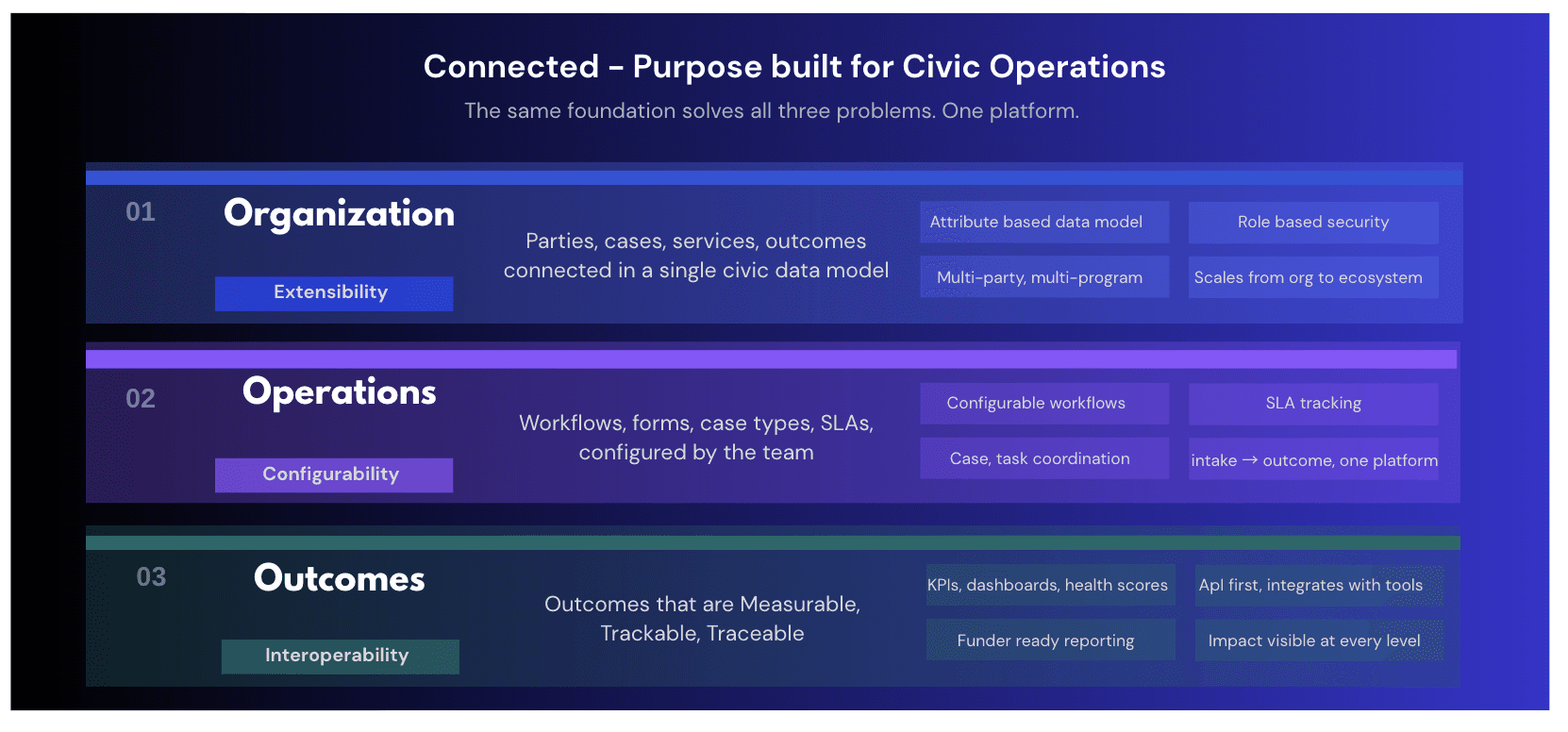
Layer 1: Organizations — The Civic Value Chain
Connected's data model was designed around the civic value chain: the connected chain of parties, cases, services, and outcomes that represents how civic work actually flows. Not one dimension of that chain — all of it, connected.
Parties — individuals, households, organizations, agencies, funders, and volunteers — with configurable attributes, named relationships, and cross-program history
Cases — the atomic unit of civic work: a need, the actions taken to address it, and the outcome produced, tracked from intake to resolution
Services — the programs, forms, workflows, and interventions that represent what an organization actually delivers
Outcomes — measurable, trackable, and traceable results — structured for funder reporting and AI analysis from day one
The same data model that serves a food pantry today serves a multi-agency housing coalition tomorrow. No redevelopment. No re-platforming. Add programs, verticals, and agencies on the same foundation. This is the Space advantage: the architecture scales without rebuilding.
The anxiety of missing key information disappears when the whole chain is connected — parties, cases, services, and outcomes in a single platform. |
Layer 2: Operations — Configured by the Team, Not a Developer
Connected's workflow engine was built for the people running the programs — not the IT department supporting them. Workflows, forms, case types, SLAs, and task assignments are all configured without writing code, without filing a ticket, and without waiting for a development sprint.
Configurable workflows - Intake flows, case coordination, task assignments, and escalation rules — built by the program team using the platform's configuration tools, not by a developer.
Case management - Cases tracked from intake through resolution, with complete history, assigned ownership, SLA monitoring, and breach alerts — in one place.
Application builder - Build end-to-end service applications for programs, services, and community initiatives — configured by the program team and adapted as needs evolve.
This is the Time advantage: a platform that deploys in days, adapts in minutes, and never requires a developer to keep up with the programs it supports.
The pressure of day-to-day operations eases when the platform runs the coordination — not the inbox. |
Layer 3: Outcomes — Measurable, Trackable, Traceable
Connected treats outcomes as a first-class object — not a report generated at the end of a grant cycle. Every case, every service, every party interaction produces structured data that flows directly into KPI dashboards, funder reports, and AI analysis.
KPI dashboards - Real-time visibility into caseloads, resolution rates, SLA compliance, and program health — for coordinators, managers, and leadership alike.
Funder-ready reporting - Outcomes structured to meet grant reporting requirements from day one — not exported to spreadsheets after the fact.
Interoperability - API-first architecture that flows outcomes into and out of government systems, referral networks, and existing tools — without a custom integration project.
The three-body problem in civic operations — parties, cases, and services interacting simultaneously across teams and programs — is solved not by adding more tools but by unifying them in a single platform that treats all three as connected.
The cost of heavy systems disappears when the platform is configured, not customized — and the impact is visible without a manual export. |
Part Three: What Connected Provides — Choice, Flexibility, and Value
Purpose-built doesn't mean prescriptive. Every civic organization faces its own version of the civic operations gap. Some feel it most acutely in fragmented party data. Others in chaotic operations. Others in the cost and complexity of systems that require IT to breathe.
Connected's architecture is designed to meet organizations where they are — and grow with them as they build capacity and confidence.
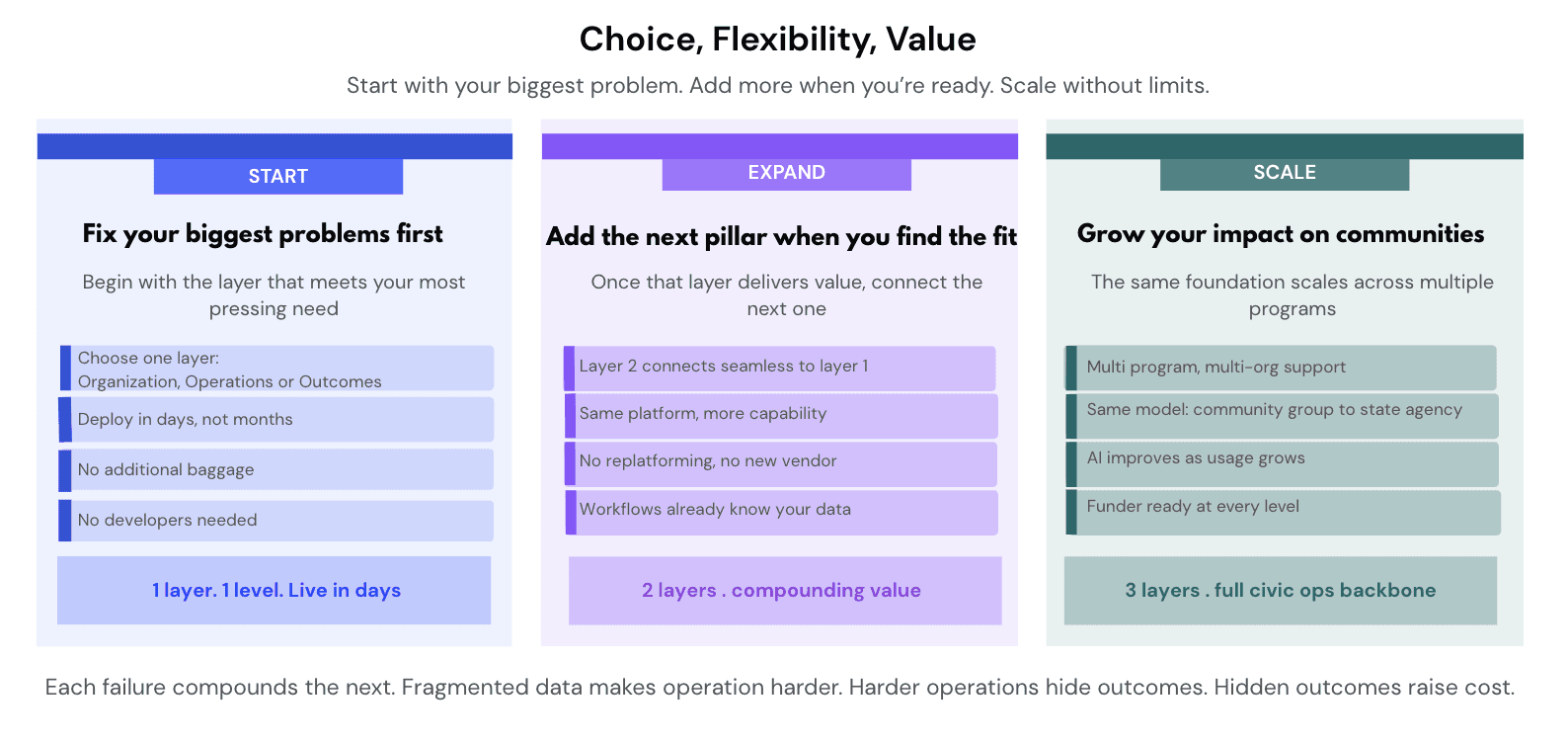
Start: Fix Your Biggest Problem First
Connected doesn't require an all-or-nothing commitment. Organizations begin with the layer that addresses their most acute pain:
Organizations layer — for organizations whose biggest challenge is fragmented data, disconnected party records, and no connected view of the civic value chain
Operations layer — for organizations whose biggest challenge is chaotic workflows, task coordination happening in email, and no structured case management
Outcomes layer — for organizations whose biggest challenge is funder reporting, IT dependency, and outcomes that can't be traced back to the operational record
Deploy in days. No additional baggage. No developer needed. No capability you don't need yet — just the layer that solves the problem in front of you.
Expand: Add the Next Pillar When You Find Fit
Once the first layer delivers value, the second connects seamlessly. This isn't a multi-year platform migration — it's adding capability on a foundation that was already designed for it.
The data model is already there. The workflows already know the parties. The outcomes already connect to the cases. Each new layer amplifies the value of the ones already in place.
No re-platforming. No new vendor. No second implementation project. The same platform, with more of it unlocked.
Scale: Grow Your Impact on Communities
The same foundation that runs one food security program runs a multi-agency housing, health, and workforce coalition. The same data model that serves 50 community members serves 50,000. The same platform that a small nonprofit deploys in a week is the one a city agency builds its civic infrastructure on.
Multi-program, multi-org — add programs, agencies, and community reach on the same data model without rebuilding
AI that improves — as usage grows, the data model grows richer, the AI improves, and the outcomes get clearer
Funder-ready at every level — from the first grant report to the state-level accountability dashboard
“Same journey. Different paths. We're all connected.”
The Organizations Doing the Most Deserve the Best Tools
The organizations enabling nutrition, education, health, housing, and financial equity across our communities have operated for too long on infrastructure built for someone else. The anxiety of missing information. The pressure of operational chaos. The cost of systems that require IT to change a workflow.
These aren't inevitable. They're design failures — and they have a design solution.
Connected was built to close the civic operations gap — not by adding another tool to the stack, but by replacing the stack with a platform purpose-built for the work. Configured, not customized. Deployed in days. Built to start where you are, expand as you grow, and scale as your communities need.
Because even with different paths, we're all on the same journey.
We're all connected.
Key Takeaways
Civic organizations face three compounding failures: fragmented party data, operational chaos, and hidden outcomes at high IT cost.
Current tools solve one dimension of the civic value chain while ignoring the rest — creating silos that compound.
Connected's three-layer architecture (Organizations, Operations, Outcomes) addresses each failure directly and amplifies the others.
Organizations can start with their biggest problem, expand to the next layer when ready, and scale without rebuilding.
Purpose-built means the platform fits the mission — configured, not customized, with no developer dependency and no implementation project.