
The organizations doing the most important work in civil society — enabling nutrition, education, health, housing, and financial equity — have had the least infrastructure to support it. They carry maximum impact with minimum acknowledgement. Maximum work with minimum resources. Maximum scrutiny with minimum tools to respond. Connected was built to change that.
This is the story of why we exist, how we’re different, and what we’re actually building.
— PART ONE
Why Connected Exists
Mission. Vision. Purpose. Three words that get used constantly and mean almost nothing when they’re abstract. Here’s what they mean for us and what they commit us to.
Mission: Bring enterprise infrastructure to where it’s needed most
“The organizations with the greatest impact on civil society have the least infrastructure to show for it.”
The nonprofit and public service sector has operated in a permanent infrastructure deficit. The tools available, when they’re available at all, are either generic platforms built for corporate contexts, or fragile workarounds built on spreadsheets and institutional memory.
Meanwhile, funders are requiring proof of outcomes. Communities are demanding more. Regulators are tightening scrutiny. The ask on these organizations has never been higher. The infrastructure to meet that ask has never kept pace.
Connected’s mission is to close that gap. To bring the operational infrastructure of an enterprise to the organizations that have always deserved it but never had access — nonprofits, local government, and public service organizations of every size.
Vision: The operational backbone for civic operations
“We want public service organizations to stand as equals to any private organization - recognized for their value, trusted in their mission, and empowered to speed and scale their impact.”
This is a deliberately ambitious statement. It doesn’t say “help nonprofits get better at reporting.” It says: stand as equals. That means operational parity — the same speed, scale, and confidence that the best-run private organizations bring to their work.
The vision has three dimensions:
Identity: Recognized for the value they create. The chain of impact from a community org to a neighborhood to civil society is real, measurable, and larger than what most private organizations ever achieve. That value should be visible.
Freedom: Trusted in their mission. Not accountability as burden. Accountability as proof. Full transparency in everything they do, so they can focus entirely on the work that matters.
Independence: Empowered to grow on their own terms. Self-reliant. Able to build services, execute operations, and measure outcomes without depending on a developer, a consultant, or a rebuild.
Purpose: Build communities through service
If the mission is what we do and the vision is what we’re working toward, purpose is why it matters beyond the platform itself.
The organizations Connected serves are the connective tissue of civil society. They’re how communities survive difficult moments — how people access food, housing, healthcare, education, and financial stability. When these organizations operate better, communities are stronger.
That’s the purpose. Not a better dashboard. Not a faster report. A stronger community.
— PART TWO
How Connected Is Different
There’s no shortage of software for nonprofits. So why build another one? Because the existing options share a fundamental problem: they weren’t built for this. They were built for something else and adapted, often badly, for the civic sector.
Connected is different in three specific ways. Not marketing claims. Architectural realities.
Purpose-built — No legacy baggage, deep domain knowledge
Most platforms in the civic sector are legacy enterprise tools with a nonprofit pricing tier. They carry years of architectural decisions made for different problems, different users, different scales.
Connected was designed from scratch around the way civic work actually flows - around parties, cases, services, and outcomes. The data model is built on how public service organizations actually think about their work, not just adapted from a corporate context and renamed.
The result is a modular architecture that spans from the data layer to workflows to UI:
Data layer: structured data objects that are clean for AI from day one
Workflow layer: configurable service flows built around program logic, not developer logic
UI layer: surfaces that match the way caseworkers, program managers, and leaders actually operate
This is the Space advantage. The same data model that serves a community group today serves a state agency tomorrow. No redevelopment. No re-platforming. Add programs, verticals, and agencies on the same foundation.
AI-native — Lightweight, agent-first, built for now
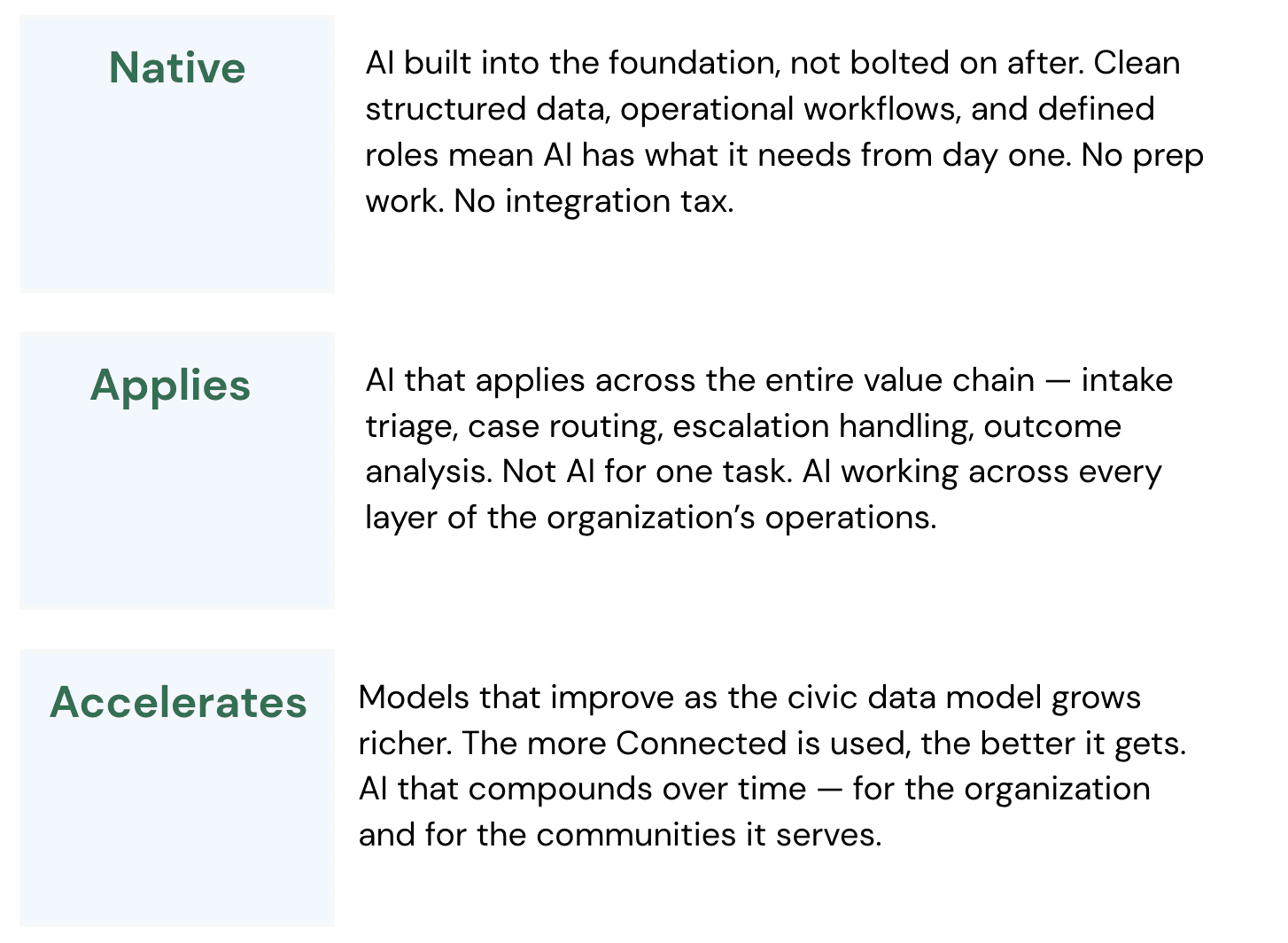
Most platforms bolt AI on after the fact. They have years of legacy architecture that AI has to work around — messy data, undefined workflows, unclear roles. The result is AI features that are impressive in demos and unreliable in practice.
“Connected isn’t a legacy platform with an AI layer. It was designed so AI works without prep.”
Connected’s architecture is lightweight and agent-first. Every AI capability has what it needs from the moment you go live: clean data objects, structured workflows, defined roles. No data cleanup project. No integration tax. No bolt-on configuration.
It’s also designed to be standalone or interoperable, meaning Connected can run independently for organizations starting from scratch, or integrate cleanly into existing tool stacks for organizations with established systems.
This is the Time advantage. Speed doesn’t come from a pitch deck. It comes from the architecture.
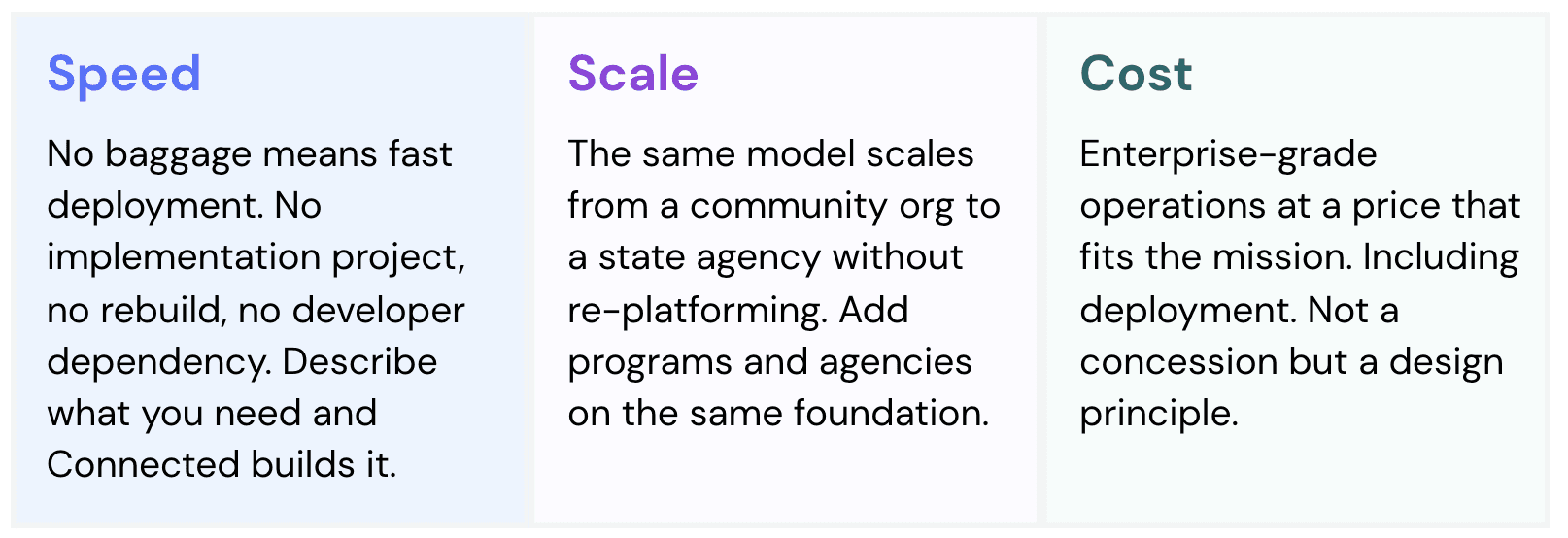
Speed, Scale, Cost — The value Connected delivers
The combination of no legacy baggage and a lightweight AI-native architecture creates something the civic sector has never had: enterprise-grade operations at a price that fits the mission.
— PART THREE
What Connected Does
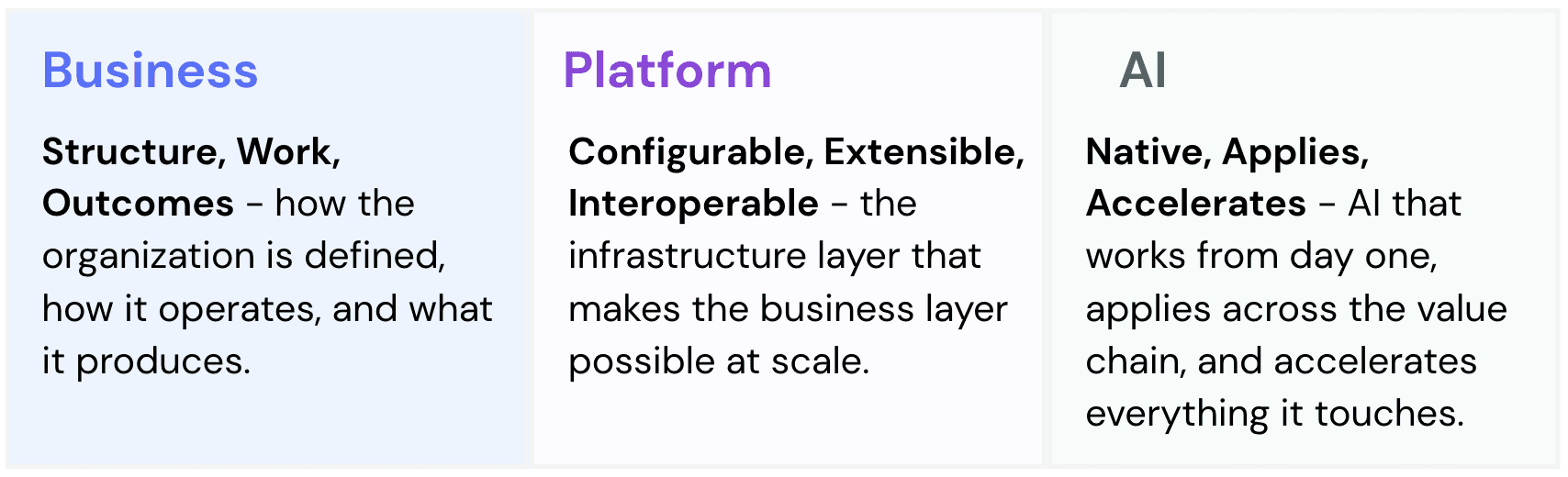
The operational backbone for civic organizations is built on a connected value chain — three layers that work together and reinforce each other. Business. Platform. AI.
The Connected Value Chain
Understanding Connected means understanding how these layers connect. They’re not independent modules. Each layer depends on and amplifies the others.
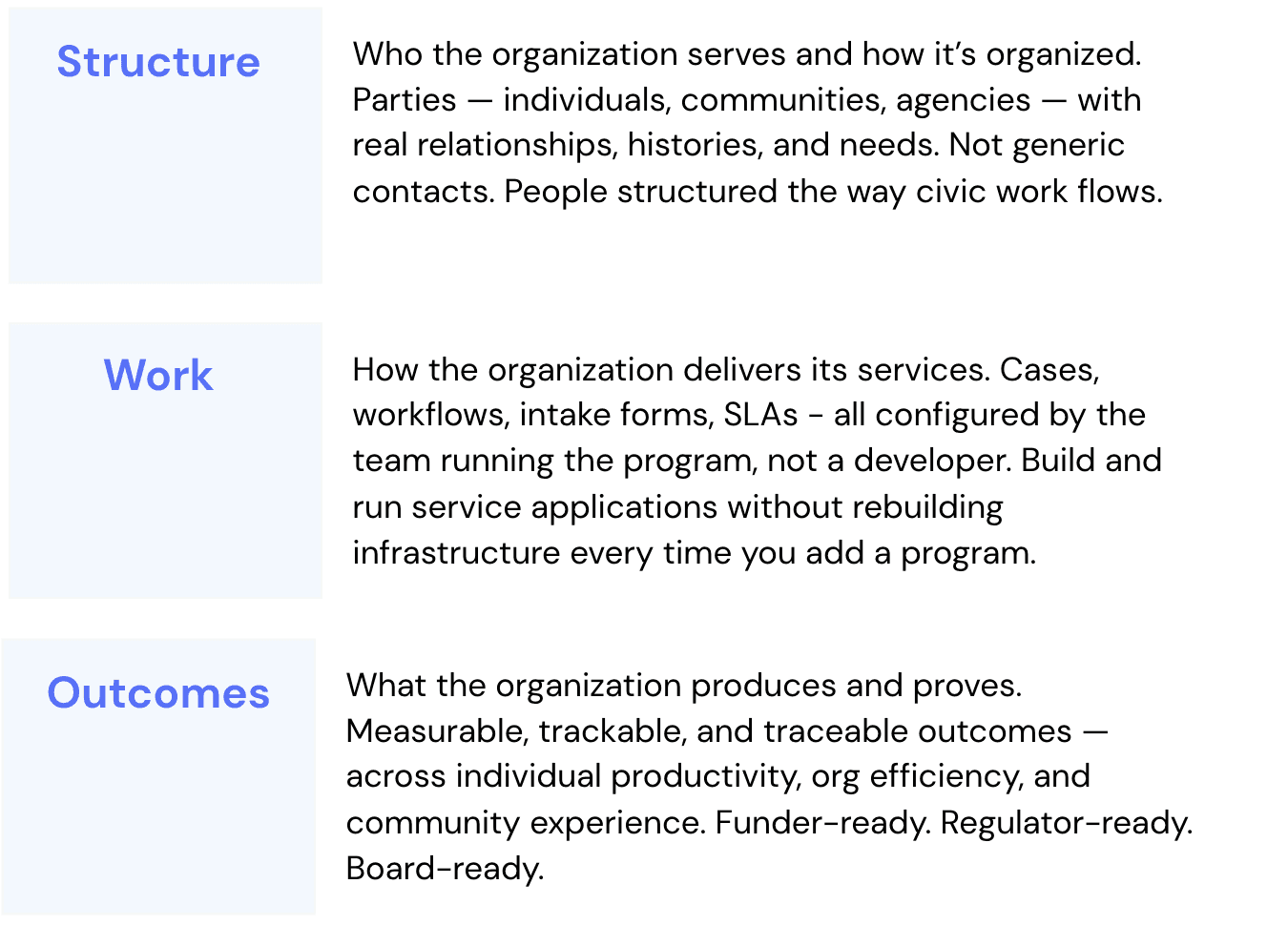
Business — Structure, Work, Outcomes
The business layer is how Connected represents the civic organization itself, and the work it does.
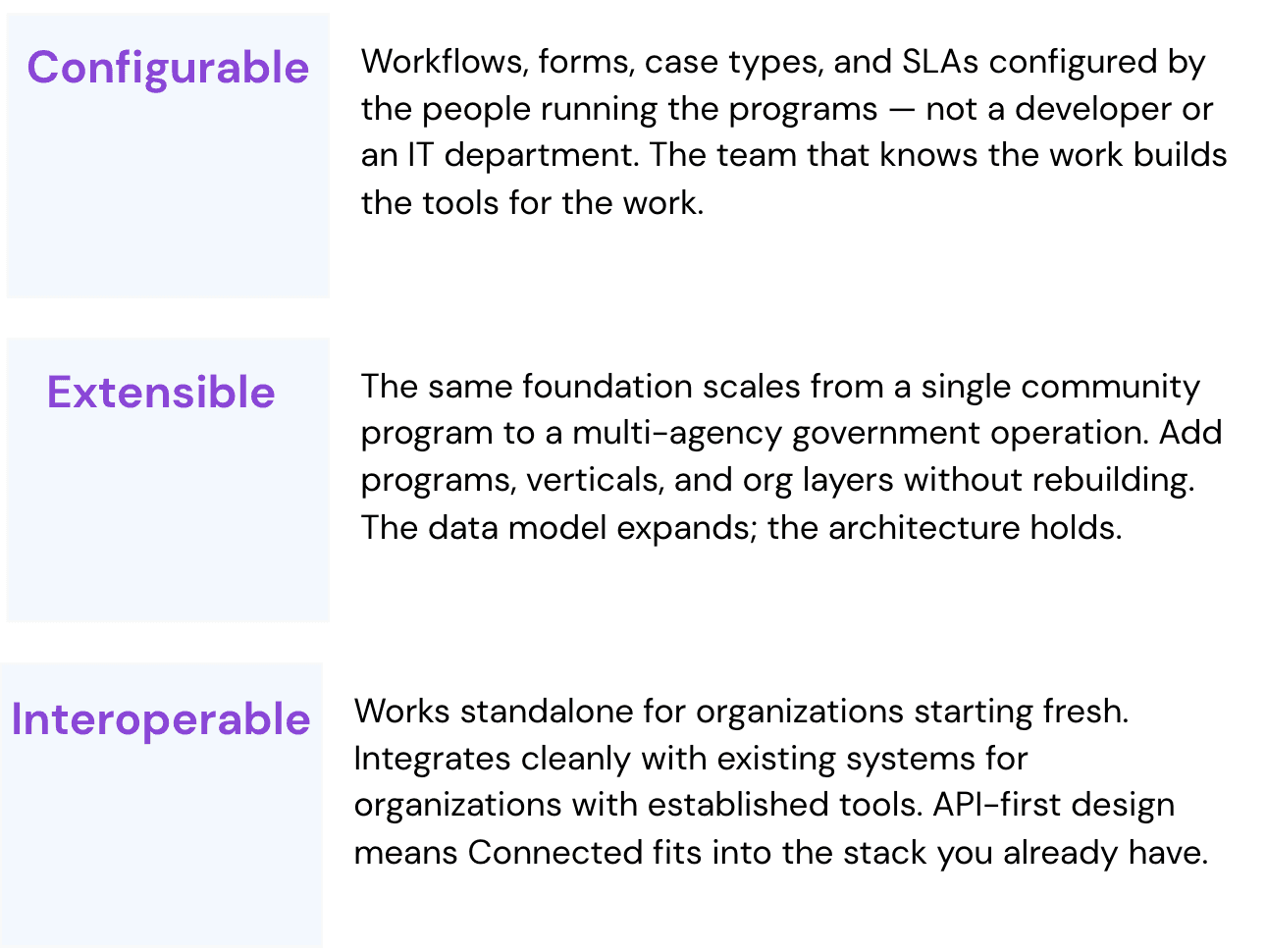
Platform — Configurable, Extensible, Interoperable
The platform layer is the infrastructure that makes the business layer real at any scale.
AI — Native, Applies, Accelerates
The AI layer isn’t a feature. It’s a design principle that runs through everything.
IN CLOSING
Because even with different paths, we’re all on the same journey.
The organizations enabling nutrition, education, health, housing, and financial equity across our communities deserve the same operational infrastructure as the largest organizations in the world.
“Connected was built to make that possible.”
Maximum work. Minimum resources. Maximum impact. Minimum acknowledgement. Maximum scrutiny. Minimum tools to respond. We know these aren’t just phrases on a website. They’re the daily reality of every organization we serve.
That’s why we built Connected. That’s how we built it differently. And that’s what we’re committed to delivering — every day, for every organization doing this work.